Millennial Temple
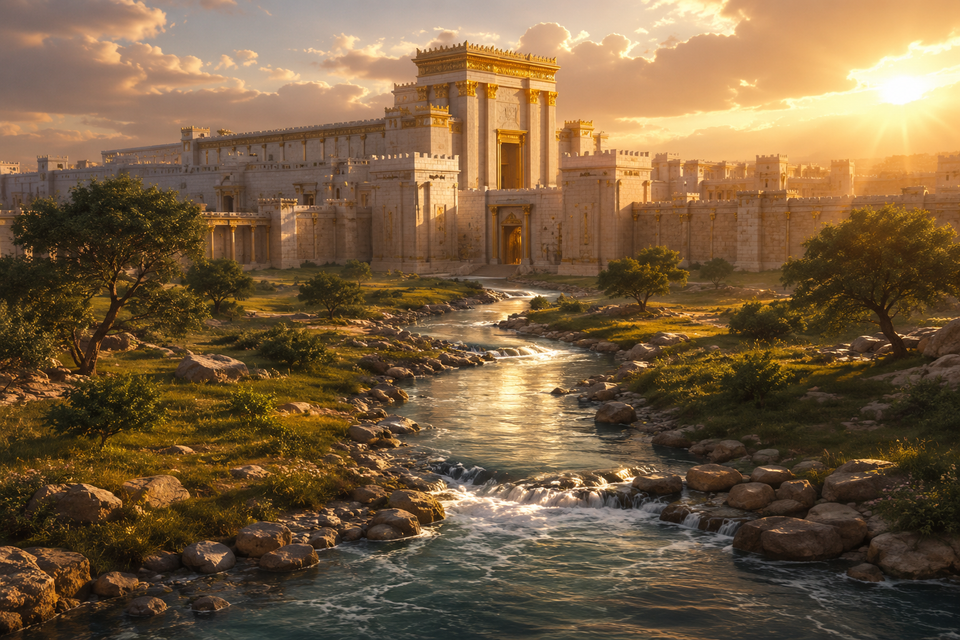
Ezekiel’s vision of the temple is one of the most misunderstood passages in all of prophetic scripture because we have been trained to read it either as architectural prediction or as symbolic poetry while missing the ache underneath it. Ezekiel is not merely describing a building. He is describing the consequence of presence. He is not giving us blueprints for a future contractor. He is showing us what happens when a people have been so wrecked by exile that God begins to rebuild their imagination from the inside out.
The tragedy is that many read Ezekiel’s millennial temple like engineers when it should be read like lovers.
Israel had lost everything. Land. Identity. Rhythm. Temple. The place where heaven and earth once kissed had become memory. And in that devastation, God does not first send military strategy. He does not send political restoration. He sends a vision of a house.
That should disturb you.
Because it reveals something profound about the heart of God. When humanity fractures, His obsession is still communion.
Ezekiel is carried into a vision of measurements, gates, chambers, courts, thresholds, altars, rivers. And for the casual reader it feels tedious. But to the awakened heart, every cubit is God saying, “I have not abandoned My desire to dwell with man.”
But here is where we must go deeper.
The millennial temple is not ultimately about geography. It is about government through presence.
We have inherited a Western habit of reducing kingdom to administration, but in scripture divine government is always first about manifested glory. Eden was government. Sinai was government. The tabernacle was government. Solomon’s temple was government. The issue was never merely authority structures. The issue was whether God was among His people in unveiled nearness.
This is why Ezekiel 43 is the hinge. The glory returns.
Do you understand the violence of that statement?
The glory had departed in Ezekiel 10. Ichabod in motion. Presence leaving because hearts had become inhospitable. And now in the latter vision, the glory comes back through the eastern gate.
This is not a small theological detail. This is cosmic reconciliation.
The God who left returns.
And if that does not undo you, then perhaps your Christianity has become more about concepts than encounter.
The eastern gate matters because direction in scripture is never accidental. East is where exile begins. Adam is driven eastward. Cain goes east. Babel emerges in the east. East becomes the geography of estrangement. So when glory returns from the east, it is God reversing exile.
Read that again.
The direction of departure becomes the direction of restoration.
That is how God heals.
He does not merely erase history. He redeems the wound itself.
And then comes the river.
This is where shallow readers lose the plot.
The temple is not static. It leaks.
That should challenge every institutional understanding of spirituality that defines success by containment.
The true temple cannot keep glory to itself.
Water flows from beneath the threshold. Not from the altar. Not from the priestly chambers. From beneath the threshold.
Why?
Because even the places we think are insignificant become portals when presence dwells among us.
The river starts small enough to ignore.
Ankle deep.
And that is where most believers are comfortable.
Enough God to feel inspired. Not enough God to lose control.
Then knee deep.
Now movement changes.
Then waist deep.
Now your center of strength is compromised.
Then waters to swim in.
And here is the confrontation.
Most modern spirituality is designed to keep you ankle deep while calling it maturity.
We want inspiration without surrender. Revelation without transformation. Glory without death.
But Ezekiel’s river is merciless.
It keeps rising until self governance becomes impossible.
And perhaps that is the point.
The kingdom is not your enhancement plan.
It is your end.
The river heals the Dead Sea.
Think about that.
The most lifeless geography in the region becomes abundant because of one thing. Flow from the house.
Religion tells dead places to try harder.
Presence makes dead places alive.
But the temple itself raises difficult questions, especially for serious readers.
Animal sacrifices appear in the vision.
Priestly functions continue.
Measurements remain literal in tone.
So what do we do with that in light of Christ?
This is where simplistic certainty becomes dangerous.
Some insist this must be a literal future millennial structure with memorial sacrifices pointing backward to the cross.
Others insist it is entirely symbolic and never intended materially.
But perhaps both camps sometimes miss the larger prophetic pattern.
Biblical prophecy often works with layered fulfillment.
The temple is theological language before it is construction language.
Even the New Testament destabilizes purely physical readings.
Jesus says destroy this temple and in three days I will raise it.
John tells us He spoke of His body.
Paul says we are the temple.
Peter calls believers living stones.
Revelation ends not with a temple restored but with no temple, because the Lord God Almighty and the Lamb are its temple.
So what is Ezekiel seeing?
I would argue he is seeing the architecture of communion through prophetic vocabulary available to him.
He sees ultimate restoration through categories his covenantal world can comprehend.
But do not make the mistake of flattening that into abstraction.
Because prophetic symbolism is not less real. It is often more real.
The question is not whether Ezekiel’s temple exists.
The question is where.
And if your answer is only someday, somewhere, then perhaps you have postponed realities Jesus inaugurated.
The millennial reign itself is often discussed like an escape room chart.
Timelines. Nations. Thrones. Resurrections.
Fine.
But if your eschatology does not produce hunger for presence, then it has failed.
The reign of Christ is not fundamentally about improved geopolitics.
It is about the full subjugation of creation to divine intimacy.
What if the temple vision is less about satisfying speculative curiosity and more about confronting our aversion to holiness?
Because the measurements are relentless.
Everything is measured.
Why?
Because glory is not vague.
We love undefined spirituality because it makes no demands.
But Ezekiel’s God measures thresholds, chambers, walls, courts.
Not because He is obsessive in the way we imagine control.
Because holiness has form.
Presence is not chaos.
Love is wild, yes, but never disordered.
And here is the deeper offense.
Access is structured.
Not because God wants distance, but because untransformed humanity cannot survive unveiled fire.
The story of scripture is not God resisting closeness.
It is God preparing humanity for it.
This is why Jesus matters beyond sentimental salvation language.
He is not merely the forgiver of mistakes.
He is the one in whom temple reality becomes embodied.
He is gate, priest, sacrifice, altar, glory, and river.
Which means Ezekiel’s vision finds its yes in a person before it finds its completion in an age.
And yet even that statement should not let us off easy.
Because if Christ is the temple, then why do so many communities built in His name feel spiritually barren?
Why are gatherings polished but powerless?
Why are sermons informed but not incendiary?
Why do we have systems but so little glory?
Perhaps because we have learned to host religion without surrendering to presence.
Ezekiel’s temple is terrifying because it reveals how much of our spirituality would collapse under actual glory.
Control would collapse.
Performance would collapse.
Branding would collapse.
Celebrity would collapse.
Hidden compromise would collapse.
The river does not negotiate with your curated image.
It carries away whatever cannot survive truth.
And maybe that is why many prefer theology about presence to presence itself.
Presence costs too much.
Because the endgame of presence is transformation.
Not attendance.
Not emotional uplift.
Transformation.
The final verse of Ezekiel gives the city a name.
The Lord is there.
That is the climax.
Not architecture.
Not priesthood.
Not political restoration.
Presence.
Yahweh Shammah.
The Lord is there.
That is the ache beneath every human ambition whether acknowledged or not.
We build careers hoping the Lord is there.
We pursue relationships hoping the Lord is there.
We construct ministries hoping the Lord is there.
We gather knowledge hoping the Lord is there.
Because success without presence is still exile.
And here is the question the vision throws at us.
If God actually came near in the way we claim to desire, what would have to die?
Not theoretically.
Actually.
What habits?
What compromises?
What identities?
What doctrines that protect distance?
What version of Christianity built around convenience rather than surrender?
The millennial temple is not safe reading.
It is a summons.
A confrontation.
A prophetic invasion into our carefully managed spirituality.
Because the true scandal is not whether Ezekiel saw a literal building.
The true scandal is that God still desires to dwell among a people who consistently resist being made ready for Him.
And yet He comes.
That is grace.
But grace is not permission to remain shallow.
Grace is the invitation to go deeper until the river takes your feet off the ground.
So here is the challenge.
Stop asking whether you can map the temple.
Ask whether you could survive it.
Because the ones obsessed with dimensions may be missing the glory.
And the glory has never been looking for tourists.
Only hosts.
If you feel led to partner with what God is doing through this ministry, we invite you to sow into this work as the Spirit leads. Your generosity helps us continue to share His love and truth with others. There is no obligation only an opportunity to join in what God is building. Thank you for considering being a part of this journey.
Member discussion