The Bag and the Blood
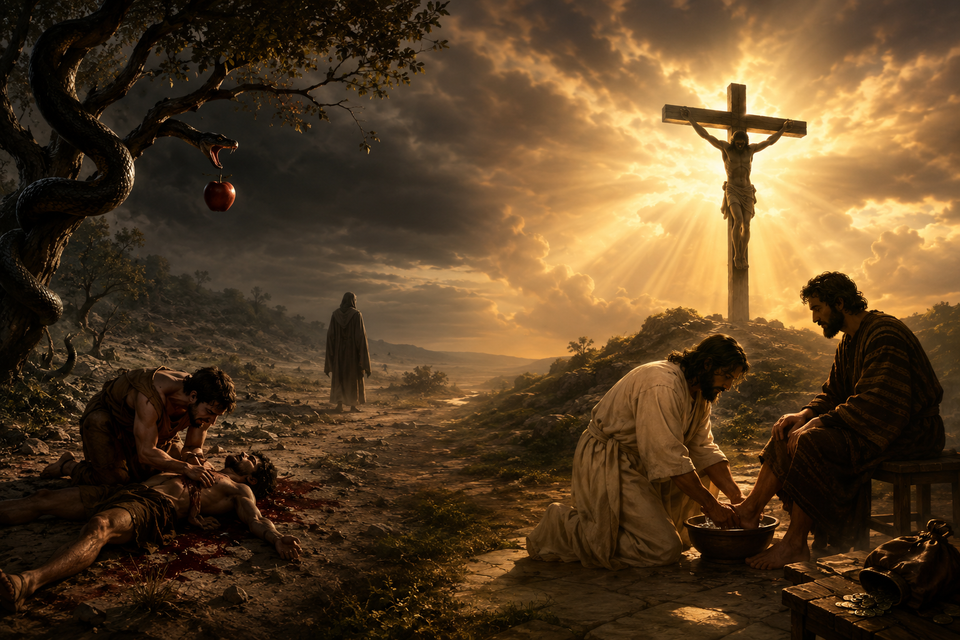
Before there was blood in the ground, there was a lie in the garden. Before Cain ever raised his hand against Abel, before a brother became a murderer, before the earth opened its mouth and received innocent blood, something had already entered the human story that was more dangerous than the weapon Cain would eventually use. A voice had questioned God. “Yea, hath God said?” The serpent did not place violence into Eve’s hand. He placed suspicion into her heart. He did not begin by telling humanity to hate God. He suggested that God could not be trusted.
Listen to the temptation carefully. “God doth know that in the day ye eat thereof, then your eyes shall be opened, and ye shall be as gods.” There it is. The serpent takes the goodness of God and places a shadow over it. Perhaps He is withholding something from you. Perhaps obedience is keeping you from something you deserve. Perhaps there is a version of you beyond surrender that God does not want you to discover. And once the goodness of God becomes questionable, self preservation begins to feel like wisdom. Self promotion begins to feel like freedom. Self government begins to feel like enlightenment.
The first lie was never merely about fruit. It was about the throne.
And by Genesis 4, the serpent is no longer speaking from a tree. The lie has found somewhere else to live.
Cain comes before God with an offering. Genesis says that “Cain brought of the fruit of the ground an offering unto the LORD.” Imagine the smoke rising. Imagine the smell of the offering hanging in the air. Two brothers standing before God. Two offerings presented. Two men waiting beneath the gaze of the same Lord. Then Scripture says that God had respect unto Abel and to his offering, “but unto Cain and to his offering he had not respect.”
And Cain was very wroth.
Watch what happens next, because God does not abandon Cain to his anger. God comes to him. “Why art thou wroth? and why is thy countenance fallen?” Then God warns him, “sin lieth at the door. And unto thee shall be his desire, and thou shalt rule over him.”
There was still a door.
There was still a moment.
There was still a voice calling Cain back before the field ever became a crime scene.
Cain could have allowed the rejection of his offering to become the correction of his heart. He could have fallen before God and said, “Show me.” He could have let God change Cain. But the thing living inside self would rather rearrange the world around it than surrender the throne within it.
So Abel became the problem.
That is the strange cruelty of selfishness. Abel had taken nothing from Cain. Abel had not withheld anything from Cain. Abel had not stood between Cain and repentance. Abel simply pleased God, and somehow the righteousness of one brother became unbearable to the other. First John 3 reaches all the way back into Genesis and tells us what was moving beneath the surface: “Not as Cain, who was of that wicked one, and slew his brother. And wherefore slew he him? Because his own works were evil, and his brother’s righteous.”
John does not merely tell us Cain did something wicked. He says Cain “was of that wicked one.”
Then Jesus opens that language further in John 8. Speaking to men who resisted the truth standing directly in front of them, He says, “Ye are of your father the devil, and the lusts of your father ye will do.” And listen to the two things Jesus joins together when He describes that father: “He was a murderer from the beginning,” and “he is a liar, and the father of it.”
A liar.
A murderer.
Perhaps those are not two unrelated descriptions.
Perhaps murder is what the lie eventually looks like when it has been believed deeply enough that another human life becomes less valuable than the preservation of self.
The serpent lied in the garden. Cain listened to something other than the voice of God. And when the lie had finished turning Cain inward, the brother standing beside him was no longer someone to love. He was someone to remove.
It does not always begin with hatred. Sometimes it begins with the quiet rearranging of the universe until everything is interpreted according to what it means for me. Another man’s favor becomes my rejection. Another woman’s breakthrough becomes my accusation. Another person’s righteousness feels like an indictment. And eventually I can no longer celebrate my brother because I have secretly made his life a commentary on mine.
Genesis says Cain talked with Abel his brother, and then, when they were in the field, Cain rose up against him.
There is something haunting about the field.
The ground that had been created to produce fruit receives blood instead.
Then God comes.
“Where is Abel thy brother?”
And Cain answers with perhaps one of the purest sentences self has ever spoken.
“I know not: Am I my brother’s keeper?”
Do you hear it? Why should his life be my concern? Why should his condition place a demand upon me? Why should I carry responsibility for somebody who is not me?
Cain had brought God an offering, but when God asked him about his brother, the altar could no longer hide what was inside him. And if the long history of the human heart has taught us anything, it is that what we place upon an altar can sometimes be easier to surrender than the self standing before it.
And thousands of years later, another man would live near holy things while something hidden remained alive.
Judas did not meet Jesus once. He walked with Him. Dust from the same roads covered their feet. He heard the same parables that rearranged the lives of others. He watched bread multiply in the hands of Christ. He saw demons come out. He watched bodies respond to a word. He sat close enough to Truth to hear Him breathe.
Yet John gives us a glimpse beneath the ministry.
When Mary poured the costly ointment upon Jesus, Judas protested. “Why was not this ointment sold for three hundred pence, and given to the poor?” If John had stopped there, Judas might have sounded compassionate. But John does not stop there. “This he said, not that he cared for the poor; but because he was a thief, and had the bag.”
He had the bag.
Feel the weight of it hanging against him while he walks beside Jesus.
That bag had become more than something Judas carried. Somewhere along the road, what was in the bag began carrying Judas. His mouth could speak about the poor while his hand knew the familiar weight of money that did not belong to him.
Self had learned the vocabulary of ministry.
His lips said poor.
His heart said me.
Then the language becomes darker.
John 13 says that “the devil having now put into the heart of Judas Iscariot, Simon’s son, to betray him,” supper was underway. Something had been put into the heart. Then Jesus rises from the table, lays aside His garments, takes a towel, pours water into a basin, and begins washing feet.
Do not move past that room too quickly.
Betrayal is in Judas’s heart.
A towel is in Jesus’s hands.
The man who will sell Him is sitting at the table, and the One who knows everything kneels.
There are two kingdoms in that room, and neither needs a throne to reveal itself. One is calculating what it can gain. The other is washing feet.
Then John tells us that after Judas received the sop, “Satan entered into him.”
Luke 22 says it with the same dreadful clarity: “Then entered Satan into Judas surnamed Iscariot, being of the number of the twelve.”
Being of the twelve.
Not standing outside the movement.
Inside it.
Not unfamiliar with Jesus.
Close to Him.
The serpent once whispered from a tree. Now the lie has found a disciple willing to carry it into a garden.
And listen to what follows in Luke. Judas goes to the chief priests and captains and “communed with them how he might betray him unto them.” They agree to give him money.
Thirty pieces of silver.
You can almost hear the coins strike one another.
Thirty small metallic sounds measuring what self has decided Jesus is worth.
That is where Cain and Judas meet. Not merely in murder. Not merely in betrayal. They meet where self becomes so central that someone else can be sacrificed to preserve what self wants.
Cain looked at Abel and chose Cain.
Judas looked at Jesus and chose Judas.
Both stood near truth. Cain heard God Himself ask him why his countenance had fallen. Judas heard Truth Himself speak across the table. Neither suffered from a lack of revelation. They suffered from allegiance to another voice.
And every lie of the serpent eventually turns the soul inward because the ancient lie has never changed. God cannot be trusted, therefore you must take care of yourself first. What you want begins to feel necessary, and what God has not given begins to feel like something you have been denied.
Then Christ appears.
Not simply as another man resisting the ancient lie, but as a life moving in the opposite direction entirely.
This is where First John 3 refuses to leave us staring at Cain. John takes us from the brother who takes life to the Brother who lays His life down. “Hereby perceive we the love of God, because he laid down his life for us.”
Cain takes his brother’s life.
Judas sells his Lord’s life.
Jesus lays down His own life.
Cain says with his actions, Your blood is worth my wounded pride. Judas says with thirty pieces of silver, Your blood is worth what I can gain. Then Jesus walks toward Calvary and says something neither Cain nor Judas could say while self occupied the throne.
My blood for you.
The serpent reaches upward. “Ye shall be as gods.” Jesus comes downward and takes the form of a servant. The serpent awakens the appetite to ascend, to possess, to seize what has not been given. But Jesus descends. Lower into flesh. Lower into servanthood. Lower beneath the towel. Lower beneath the cross. Lower still, until the One through whom all things were made is hanging naked before the world He made, with nothing clenched in His hands.
And now Cain’s question returns.
“Am I my brother’s keeper?”
First John 3 answers it, but not with philosophy. “We ought to lay down our lives for the brethren.” Then John brings it painfully close: if a man possesses this world’s goods, sees his brother in need, and shuts up his compassion, “how dwelleth the love of God in him?”
Cain asks how little responsibility he can have for his brother.
Jesus answers that question with wounds.
This is why the opposite of Cain is not merely a man who refuses to murder. The opposite of Cain is Christ. The opposite of selfishness is not niceness. It is crucified love. It is a life that has been so delivered from the lie of self preservation that another person’s flourishing no longer threatens it, another person’s blessing no longer diminishes it, and another person’s need can actually become an invitation to pour itself out.
The devil is called a liar and a murderer. Jesus calls Himself the Truth, and when the Truth finally stands before Pilate, He does not grasp for the power to save Himself. He walks on toward the hill.
And somewhere between the serpent and the cross stands every human heart, deciding which voice deserves worship.
So come back to the altar. The smoke is still rising. Cain is standing there with something in his hands, Abel is standing nearby, and God is looking deeper than what either man has brought. Judas is still sitting at the table with the weight of the bag against him, while Jesus kneels low enough to wash the feet that will soon carry a betrayer into the night. And now there is another altar before us, one shaped like a cross, where the Truth refuses to preserve Himself and instead pours Himself out completely.
The question is not whether you have brought something to God.
The question is, when you come to the altar, what are you still refusing to put on it?
If this ministry has encouraged your walk with Christ and you feel led by the Lord to partner with what He is doing, we invite you to prayerfully consider supporting this work. Every gift helps us continue sharing the truth of God’s Word and the hope of the gospel with people around the world.
There is never any obligation to give, only an opportunity to participate in what God is doing. We are deeply grateful for your prayers, your encouragement, and, if the Lord leads, your generosity.
You can give here: Awaken Ministries Donation Page
Member discussion