The grace to let go
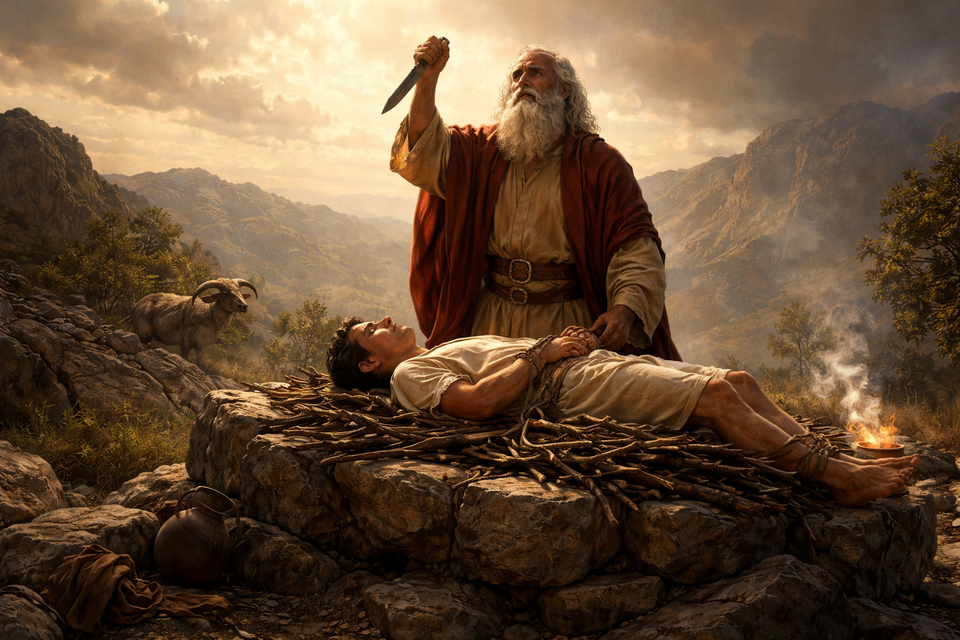
There is a moment in the life of Abraham that rarely gets preached without triumph at the end. We rush to the ram in the thicket. We celebrate the provision. But we often skip past the long quiet walk up the hill, where obedience looked like loss and faith felt like contradiction.
Genesis tells us that God asked Abraham to take Isaac, his son, the promise, the laughter, the future, and offer him on a mountain God would show him. There is no record of Abraham arguing. No visible bargaining. No delay. Just a quiet rising early in the morning and a long journey with wood, fire, and a question that would eventually come from Isaac himself.
Where is the lamb.
That question echoes through every season where God asks us to release what He once gave.
Abraham was not being tested for cruelty. He was being invited into trust at a depth he had never known. Isaac was never meant to die. But Isaac had to be released, because the promise had slowly become the proof. And God will never allow His gifts to replace His voice.
This is where the grace to let go becomes both holy and terrifying.
Abraham had waited decades for Isaac. He had aligned his entire future around this boy. Every dream, every plan, every expectation now had a name and a face. Isaac was not just something Abraham loved. Isaac was what made Abraham feel certain.
And that is often where the trouble begins.
God does not compete with idols made of stone alone. He also puts His finger on promises we have quietly turned into guarantees. When our confidence rests more in what He gave than in who He is, He will lovingly disrupt the arrangement.
Notice something crucial. God did not say, Abraham, you failed. He did not say, Isaac is bad. He did not accuse Abraham of sin. He simply said, take what you love and give it back to Me.
Release is not rejection. It is recalibration.
Many people struggle here because they assume if God asks for something, it means it was wrong to begin with. But that is not how God works. Some things are right for a season and dangerous if carried beyond it. Isaac was a miracle. But Isaac was not meant to be possessed.
Abraham walked three days toward the mountain. Three days of silence. Three days of opportunity to turn back. Three days where nothing changed externally, but everything was shifting internally. This is often how God works with us. He gives us time to feel the weight of what we are releasing, not because He enjoys our pain, but because love that has never been tested cannot be trusted.
The hardest part of letting go is not the loss itself. It is the space between obedience and outcome. Abraham did not know about the ram. He did not know the ending. All he knew was that God had spoken, and obedience would cost him everything he thought he needed.
This is where many believers stop short.
We say yes to God when obedience feels fruitful. We follow Him when the story makes sense. But when He asks us to lay something down without explanation, without replacement, without reassurance, we hesitate. We spiritualize our fear. We call it wisdom. We call it responsibility. But underneath it is often a quiet terror of losing control.
Abraham bound Isaac.
There is no way to soften that moment. No theological shortcut. No poetic interpretation. This was real obedience with real tension. Isaac was old enough to ask questions. Strong enough to resist. And yet, he lay there.
Which tells us something else. Sometimes release involves people who do not fully understand what God is doing in you. Sometimes obedience looks like confusion to those closest to you. And still, you must obey.
When Abraham raised the knife, heaven interrupted. Not before. Not during the journey. Only at the point of full surrender.
This is important.
God often waits until your grip is fully open before He speaks again, because partial surrender still leaves room for control. And control always distorts intimacy.
The angel called Abraham by name. Abraham, Abraham. There is tenderness in repetition. God was not distant. He was attentive. He had been watching the entire time.
Do not lay a hand on the boy.
In that moment, Abraham learned something deeper than provision. He learned that God was never after Isaac. He was after Abraham’s trust. The ram was already there. Provision was not a reaction. It was preparation.
But Abraham could not see it until he released what he was holding.
This is where our stories intersect with his.
There are things God is no longer asking you to carry. Not because they are sinful. Not because you failed. But because the season has shifted. The grace that once made it light has lifted. The joy has drained. The striving has increased. And you are tired in a way rest does not fix.
You keep telling yourself if you push harder, it will come back. If you pray louder, it will return. But what if the heaviness is not resistance, but release.
What if God is inviting you up a mountain, not to take something from you, but to free you from what you have been using to feel secure.
Letting go does not always feel noble. Sometimes it feels like everything is falling apart. Relationships shift. Structures weaken. People misunderstand your silence. What once worked no longer does.
This is not always attack. Sometimes it is alignment.
Abraham named the place The Lord Will Provide. But provision did not come until after surrender. And provision did not look like Isaac disappearing. It looked like Isaac returned differently. No longer owned. No longer clutched. No longer the source of Abraham’s certainty.
This is the grace of letting go. You may get some things back. You may not. But whatever returns will be purified, held loosely, trusted rightly.
Some of you are holding Isaacs God never asked you to kill, but He is asking you to release. Ministries, roles, relationships, expectations, identities that once came from obedience, but are now maintained by fear.
And the fear whispers, if you let go, everything will unravel.
It might.
But unraveling is not always destruction. Sometimes it is deliverance.
God is not threatened by collapse. He specializes in resurrection. But resurrection only comes where there has been a willingness to lay something down.
Abraham walked down the mountain with Isaac. But Abraham was not the same man who walked up. Something had shifted. He trusted God beyond outcomes. He knew God was faithful beyond understanding.
This is what God wants for you.
Not productivity without intimacy. Not obedience without trust. Not fruit without surrender.
There is grace available to let go of what God is no longer asking you to do. Grace to stop striving. Grace to release outcomes. Grace to trust God with what happens after you obey.
Even if things fall apart.
Especially if they do.
Because the God who calls you is already waiting on the other side of surrender. And He is far more committed to you than to anything you are afraid to release.
If you feel led to partner with what God is doing through this ministry, we invite you to sow into this work as the Spirit leads. Your generosity helps us continue to share His love and truth with others. There is no obligation only an opportunity to join in what God is building. Thank you for considering being a part of this journey.
Member discussion