The Holy Spirit Is Not an Accessory
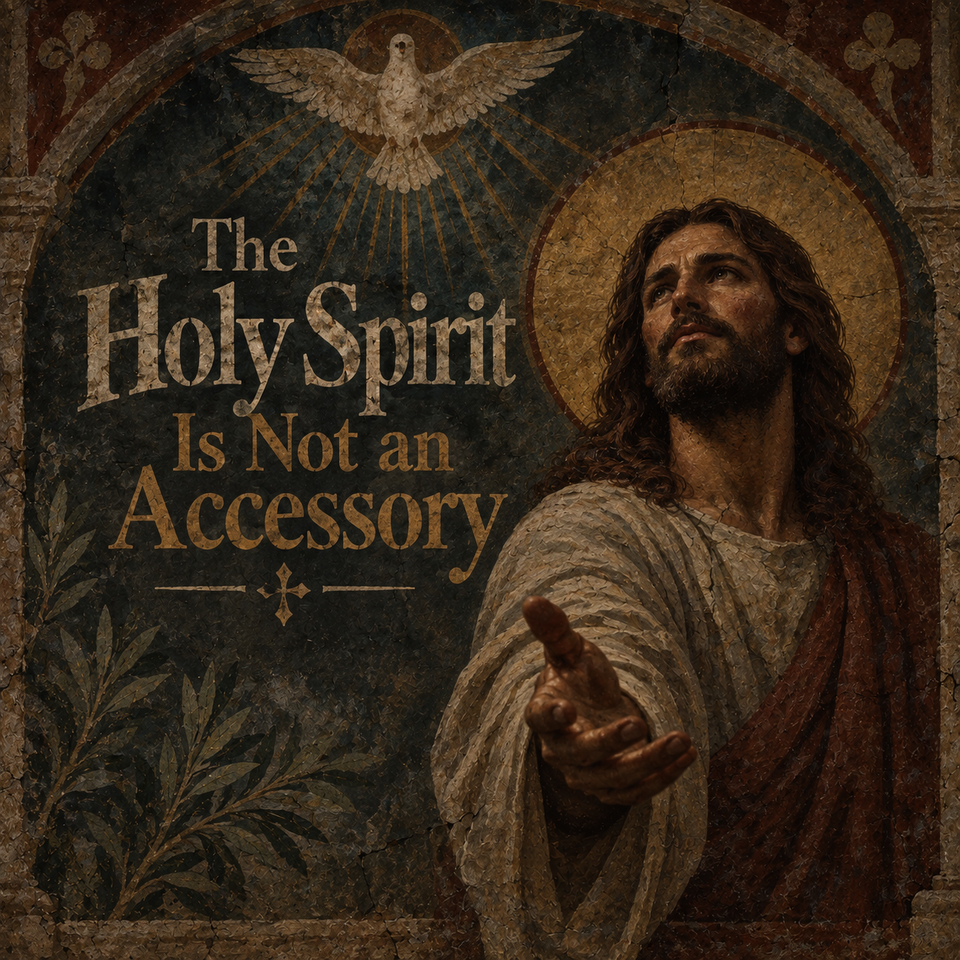
There is a tragedy in much of modern Christianity. We have learned how to talk about Jesus while barely knowing the Spirit Jesus promised. We have developed language for the Father, theology concerning the Son, and then sometimes treated the Holy Spirit as though He were an atmosphere that arrives when the music gets good.
But the Holy Spirit is not an atmosphere. He is not a feeling. He is not a theological accessory.
He is God.
He is Lord.
And because He is fully God, He shares in the saving identity and work of God.
Peter gives us one of the clearest statements in Acts 5. Ananias lies concerning the money from the land, and Peter asks, “Why has Satan filled your heart to lie to the Holy Spirit?” Then he says, “You have not lied to men but to God.”
The Spirit of God in the Beginning
Genesis 1:2 says, “And the Spirit of God was hovering over the face of the waters.” The Hebrew word for Spirit is Ruach. It can communicate spirit, breath, or wind depending upon context. The text identifies the One hovering over the waters as Ruach Elohim, the Spirit of God.
That matters because the Spirit does not suddenly appear late in the biblical story. Open the Bible to its first chapter and He is already there, present over the waters before the ordering of creation unfolds.
Then David cries in Psalm 51:11, “Do not take Your Holy Spirit from me.” The Hebrew expression is Ruach Qodshekha, “Your Holy Spirit.” What Genesis identifies, David treasures as the presence he cannot bear to lose.
And Isaiah 63:10 takes us somewhere different. Israel “rebelled and grieved His Holy Spirit.” The language is personal. The Holy Spirit can be grieved. Scripture will not permit us to reduce Him to an influence or atmosphere.
The Holy Spirit Is Savior
We need to say this carefully because strong theology does not need careless exegesis.
Titus 3:4 begins, “But when the kindness and the love of God our Savior toward man appeared,” and verse 5 declares, “not by works of righteousness which we have done, but according to His mercy He saved us.”
Then Paul tells us how:
“Through the washing of regeneration and renewing of the Holy Spirit, whom He poured out on us abundantly through Jesus Christ our Savior.”
The wording matters. Paul explicitly calls the Father “God our Savior,” and then explicitly calls Jesus Christ “our Savior.” He does not place the title Savior directly after the Holy Spirit. We should not pretend that he does.
But Acts 5 has already shown us that the Spirit is fully God. And Scripture calls God Savior. So we do not make the Spirit less than God when we speak about salvation. He fully shares the identity of the one God who saves, even though Titus 3 does not directly give Him the title Savior.
Titus then shows us what the Spirit does in that salvation. God “saved us” through “the washing of regeneration and renewing of the Holy Spirit.”
The Greek word translated regeneration is palingenesia. It speaks of new birth, new beginning, new life. The title Savior belongs explicitly to the Father and the Son in this sentence. The regenerating and renewing work is attributed to the Holy Spirit. Both truths matter.
Jesus says in John 3:5, “Unless one is born of water and the Spirit, he cannot enter the kingdom of God.” Then He says, “That which is born of the Spirit is spirit.”
Christianity is not sinful people learning religious behavior.
Christianity is dead people receiving life.
Somebody in here needs to hear this because you have spent years trying to improve what God intends to resurrect. You cannot discipline a corpse into life. You cannot educate a corpse into life. You cannot bring enough religious activity around dead things and call them alive. Jesus said you must be born of the Spirit.
Second Thessalonians 2:13 speaks of “salvation through sanctification by the Spirit and belief in the truth.” First Corinthians 6:11 says, “You were washed, but you were sanctified, but you were justified in the name of the Lord Jesus and by the Spirit of our God.”
And maybe this is where the question gets uncomfortable. Are you asking God merely to make you better at managing the old life, or have you actually surrendered to the Spirit who gives new life? There is a difference between wanting help with what you have built and consenting to the regeneration Jesus says you need.
The Spirit Is Lord
Second Corinthians 3:17 says, “Now the Lord is the Spirit; and where the Spirit of the Lord is, there is liberty.”
The Greek remains striking:
Ho de Kyrios to Pneuma estin.
But context matters.
Paul has been speaking about Moses, the veil, and Exodus 34. In 2 Corinthians 3:16, he says that when one turns to the Lord, the veil is taken away. His language reaches back into the Exodus account, where the Lord is Yahweh. Verse 17 then explains this unveiled encounter in relation to the Spirit: “Now the Lord is the Spirit.”
We should not flatten a dense passage into a slogan. Paul is identifying the presence and work of the Spirit with the unveiled experience of the Lord under the new covenant. At minimum, the Spirit cannot be treated as a creature standing outside the divine presence Paul is describing.
Acts 5 gives us the cleaner starting point. Peter identifies lying to the Holy Spirit as lying to God. And when 2 Corinthians 3 speaks of turning to the Lord, liberty through the Spirit, and transformation by the Spirit, we are dealing with the divine presence and action of God.
Verse 18 says that we “are being transformed into the same image from glory to glory, just as by the Spirit of the Lord.”
The Greek word is metamorphoō. It means to be transformed.
You can call Him Lord with your mouth while keeping a room in your heart locked. You can ask for His presence while quietly deciding there are places He cannot touch. But if He is Lord, what exactly are you protecting from Him? What have you called surrender while still holding the key?
If the Spirit is God, surrender is not an optional response to an experience. If His work is to regenerate, renew, sanctify, liberate, and transform, then asking for His presence while resisting His work makes no sense.
We Need More Than a Doctrine
Paul closes 2 Corinthians with “the communion of the Holy Spirit be with you all.”
The Greek word is koinōnia.
Fellowship. Participation. Communion. Sharing.
So the question is no longer whether you can explain the Holy Spirit. The question is whether the places you have kept guarded are actually surrendered to Him. Communion cannot remain theological vocabulary while lordship is resisted.
Come Holy Spirit
Holy Spirit, take Your rightful place. Reveal what we protect from Your rule. Transform what does not reflect Christ. Make real in us the regeneration and renewal Scripture attributes to Your work.
Genesis 1:2 places the Spirit of God over the waters. Romans 8:11 says “the Spirit of Him who raised Jesus from the dead dwells in you.” Titus 3:5 speaks of “regeneration and renewing of the Holy Spirit.”
Come, Holy Spirit.
Come as the One who is fully God.
Come in Your saving, renewing, transforming work.
And let there be no locked rooms.
If this ministry has encouraged your walk with Christ and you feel led by the Lord to partner with what He is doing, we invite you to prayerfully consider supporting this work. Every gift helps us continue sharing the truth of God’s Word and the hope of the gospel with people around the world.
There is never any obligation to give, only an opportunity to participate in what God is doing. We are deeply grateful for your prayers, your encouragement, and, if the Lord leads, your generosity.
You can give here: Awaken Ministries Donation Page
Member discussion