The Power of the Circle: Escaping Linear Living to Recover Sacred Rhythm
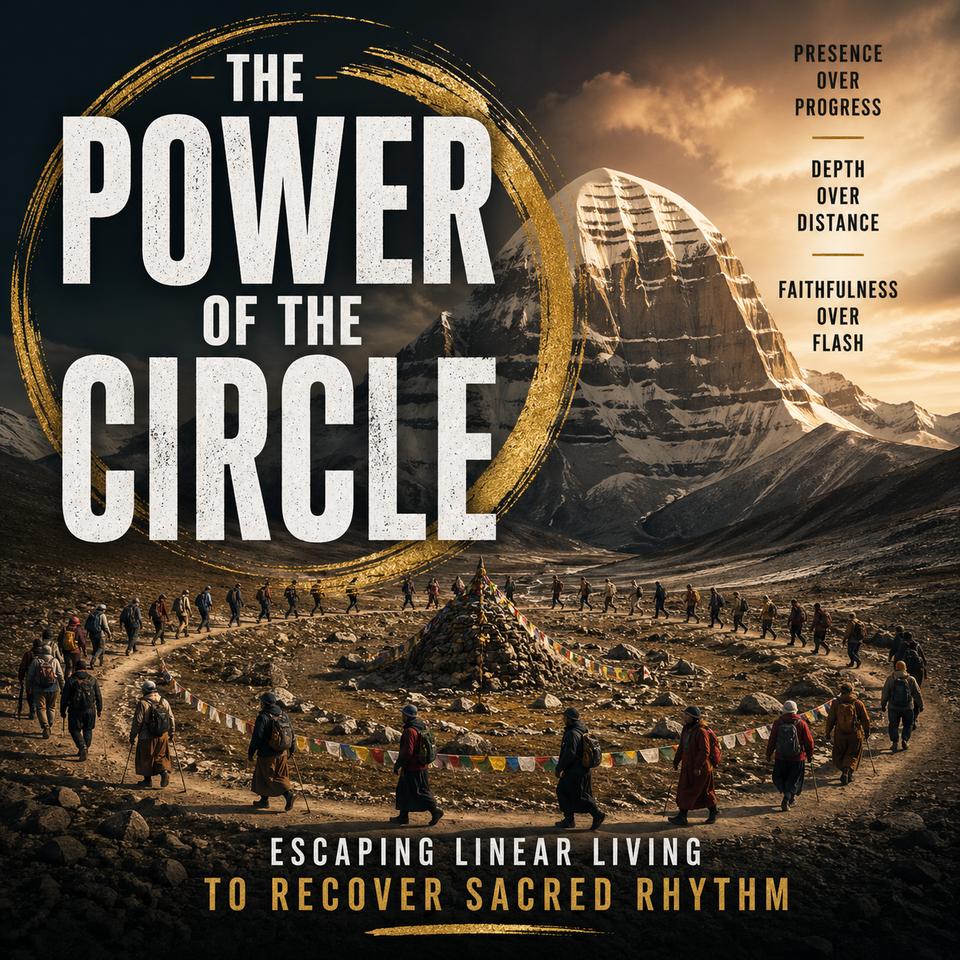
Sacred Circling
There’s something ancient and wild about the idea of kora that refuses to be reduced to a concept. It is not merely a walk. It is not exercise. It is not tourism dressed up in spiritual language. Kora is a confrontation. It is a sacred circling that pulls you out of linear thinking and invites you into a rhythm that heaven has always understood but modern life has forgotten.
At its core, kora is the act of moving around something holy. In places like Mount Kailash, pilgrims have for centuries walked miles upon miles in a circular path, believing that something happens in the repetition, in the surrender, in the refusal to rush past what is sacred. And here is where it gets disruptive for us. Because we are a people addicted to straight lines. We measure progress by how quickly we can get from point A to point B. We are obsessed with arrival. But kora laughs at that obsession.
Kora says the point is not arrival. The point is awareness.
There is a reason sacred movements are often circular. The sun rises and sets. The seasons turn. The earth itself spins in a rhythm that never hurries and never apologizes. And yet we have built lives that resist rhythm. We want breakthrough without process. We want transformation without repetition. We want encounter without devotion. Kora exposes all of that.
Because when you step into a kora, you cannot rush it.
You are forced to slow down. Step after step, breath after breath, you begin to realize that the circle is doing something to you. At first, it feels redundant. Why am I walking this same path again. Why am I passing the same stones, the same markers, the same terrain. But if you stay long enough, something begins to shift. The repetition that once felt meaningless becomes the very thing that awakens you.
This is where most people quit.
Not just in physical kora, but in the deeper spiritual reality it represents. We walk a little while. We circle a little while. But the moment it feels repetitive, we assume it has lost its value. That assumption is the lie. Because the power of kora is not found in novelty. It is found in faithfulness.
There is a transformation that only comes through returning.
Returning to the same place of prayer. Returning to the same place of surrender. Returning to the same awareness of the sacred. Over and over again until what was once external becomes internal. Until what you were circling becomes what you carry.
This is what we have missed.
We have built a culture that celebrates moments but neglects rhythms. We chase conferences, events, and emotional highs, but we struggle to remain in the slow, steady circling that actually forms us. And so we become spiritually inconsistent. Touched for a moment but not transformed in the long run.
Kora refuses that inconsistency.
It demands presence.
When you are walking a kora around something like Mount Kailash, you are not in control of the timeline. The terrain dictates your pace. The altitude tests your endurance. The journey confronts your limits. And in that confrontation, something sacred begins to happen. You start to let go of control.
And that is where the real encounter begins.
Because control is the enemy of wonder.
As long as you are managing every detail, you will never be undone by what is holy. But kora has a way of unraveling you. It strips away your urgency. It dismantles your need to perform. It invites you into a slower, deeper awareness of the presence of God.
And here is where it gets even more provocative.
Kora is not just something you do. It is something you become.
What if your life itself became a kora. What if instead of chasing the next thing, you began to intentionally circle the presence of God. Not occasionally, but consistently. Not out of obligation, but out of hunger. What if your days were marked by a returning. A coming back again and again to the place where heaven touches earth.
That kind of life would look very different.
It would not be frantic. It would not be shallow. It would carry a depth that cannot be manufactured. Because depth is always the result of sustained attention. And kora trains you in that attention.
There is also something humbling about the circle.
In a straight line, you can measure how far you have come. You can compare yourself to others. You can build a sense of progress that feeds your ego. But in a circle, those measurements begin to break down. You pass the same places. You revisit the same spaces. And you are forced to confront the reality that transformation is not about distance. It is about depth.
You can walk miles and remain unchanged. Or you can walk the same path repeatedly and be completely transformed.
The difference is awareness.
Kora invites you to see again. To notice again. To engage again. It breaks the illusion that familiarity equals understanding. Just because you have seen something before does not mean you have truly seen it. And just because you have been in a place does not mean you have fully encountered it.
This is why repetition is not the enemy.
It is the doorway.
Every time you return, you have the opportunity to go deeper. To see more clearly. To surrender more fully. And over time, that returning reshapes you. It forms something within you that cannot be produced by occasional intensity.
It produces endurance.
And endurance is what carries encounter into lifestyle.
There is also a communal aspect to kora that we cannot ignore. Pilgrims often walk together. Different backgrounds, different stories, but united in the same rhythm. There is something powerful about shared circling. About a group of people agreeing that this space, this moment, this presence is worth returning to again and again.
We desperately need that.
Because isolation weakens consistency. When you try to sustain depth alone, it becomes easy to drift. But when you are surrounded by others who are committed to the same rhythm, something strengthens. Something stabilizes. You begin to carry one another.
This is how cultures of encounter are built.
Not through occasional gatherings, but through shared rhythms. Through a collective commitment to return. To circle. To remain. Until the presence of God is no longer an event, but an atmosphere.
And that is ultimately what kora points to.
Not just a physical act, but a way of living that prioritizes presence over progress. Depth over distance. Faithfulness over flash.
It is an invitation to slow down in a world that is addicted to speed. To linger in a culture that is obsessed with moving on. To value what is sacred enough to return to it again and again.
And here is the tension.
Because everything in you will resist this.
Your mind will tell you it is inefficient. Your schedule will tell you it is unrealistic. Your habits will pull you back into linear thinking. But there is a deeper call beneath all of that. A call to step into rhythm. To embrace the circle. To trust that something is happening even when it does not feel dramatic.
Because the most powerful transformations are often the least visible in the moment.
They happen quietly. Gradually. Through consistent returning.
So maybe the question is not whether you understand kora.
Maybe the question is whether you are willing to live it.
To build a life that circles what is sacred. To return again and again to the presence of God until it becomes the center around which everything else revolves. To let go of the obsession with arrival and instead embrace the beauty of awareness.
Because in the end, kora is not about getting somewhere.
It is about becoming someone.
Someone who has learned to live in rhythm with heaven. Someone who values presence over performance. Someone who has discovered that the circle is not a limitation, but a doorway into deeper encounter.
And if you will step into that doorway, if you will commit to the circling, you may find that what you were seeking at the end of the journey was actually waiting for you in the middle all along.
If you feel led to partner with what God is doing through this ministry, we invite you to sow into this work as the Spirit leads. Your generosity helps us continue to share His love and truth with others. There is no obligation only an opportunity to join in what God is building. Thank you for considering being a part of this journey.
Member discussion