The Twelve Lampstands
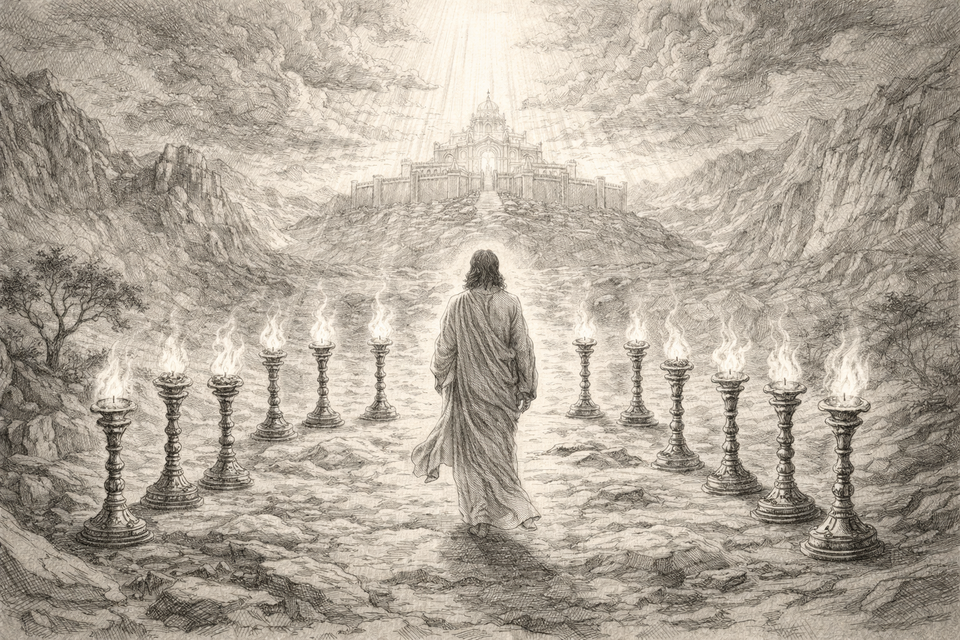
There are realities in Scripture that do not yield themselves to the casual reader. They are not hidden because God is unwilling to reveal them. They are hidden because they must be sought in reverence, prayed over in stillness, and received in the fear of the Lord. The mystery of the lampstands belongs to that realm. It is not a decorative image. It is not a minor prophetic symbol tucked away in apocalyptic language. It is a revelation of how heaven sees a people who have become capable of bearing light, hosting presence, and embodying government.
When John turned to see the voice that spoke with him, he did not first see a throne, though the throne is central. He did not first see multitudes, though multitudes surround the Lamb. He saw lampstands. He saw a formed and ordered witness in the earth. He saw light contained in structure. He saw fire married to design. And in the midst of the lampstands he saw One like the Son of Man. This is where the mystery begins. The Lord of glory chooses to reveal Himself in relation to a burning people.
That should arrest us.
The Lord is not merely looking for converts. He is not merely gathering attendees. He is not merely searching for agreement with doctrine. He is seeking a people among whom He can walk, within whom He can dwell, through whom He can shine. The lampstand is not only about illumination. It is about habitation. It is about the kind of people who no longer treat the presence of God as visitation, but have become so consecrated, so yielded, and so rightly ordered that His nearness can abide among them without resistance.
This is why the lampstand in Scripture must be understood as more than symbolism. It is anthropology in glory. It is ecclesiology in fire. It is the mystery of what man becomes when surrendered to the pattern of heaven.
The lampstand in the tabernacle was fashioned from one piece of beaten gold. Not assembled from fragments. Not patched together from unrelated materials. One piece. Hammered into beauty. Pressured into radiance. Formed by blows. Every branch, every cup, every ornament, every contour emerged through process. This is already preaching before a single flame is lit. The vessel that bears true light is not self invented. It is forged. It is shaped through dealings. It is formed through surrender. The Lord does not pour holy oil on structures we build in our own strength and call them sacred. He forms the vessel Himself.
This is where much of the modern church has lost the plot. We want light without formation. We want oil without crushing. We want fire without surrender. We want glory without government. But heaven does not permit such separation. If there is to be lasting flame, there must be a holy architecture capable of bearing it. Fire is not merely emotional intensity. Fire is the evidence that a vessel has become available to what comes from God.
So when we speak of lampstands, we are speaking of a people who have been brought into divine arrangement.
Now many rightly point to the seven lampstands in Revelation. Seven churches. Seven expressions. Seven witnesses. Seven speaks of fullness in the language of God. It speaks of completion, maturity, and the seal of divine order. But the reason you want to go deeper into twelve is because twelve is not competing with seven. Twelve is expanding the field of understanding. Seven reveals the completed witness. Twelve reveals the governmental people through whom that witness is established in history.
Twelve is everywhere in the economy of God. Twelve tribes. Twelve stones on the breastplate. Twelve loaves of the Presence. Twelve apostles. Twelve baskets left over. Twelve gates in the New Jerusalem. Twelve foundations in the city. Twelve is the number of peoplehood brought under divine rule. It is corporate identity aligned to heavenly government. It is not merely completion. It is ordered representation. It is covenant people arranged according to the pattern of God.
So when you contemplate the twelve lampstands, you are entering a prophetic meditation on a people fully aligned with divine order and fully given to divine fire. Not isolated flames. Not scattered experiences. Not independent ministries each protecting their own little spark. You are seeing a people brought into holy arrangement where light is no longer a private possession but a corporate testimony.
This matters because the kingdom of God is not built through isolated brilliance. It is built through ordered burning.
The tragedy of much contemporary spirituality is that it celebrates intensity while resisting alignment. It loves the language of awakening while despising government. It craves encounter but avoids the architecture necessary to sustain encounter across generations. Yet in Scripture the flame is never severed from order. The priests tend the lamps according to command. The oil must be pure. The wicks must be trimmed. The sanctuary must remain consecrated. Nothing about the lampstand is casual. Every detail testifies that God’s light requires God’s way.
This is why twelve takes us deeper than sentiment. It takes us into the burden of becoming a people who can carry heaven without distorting it.
The twelve lampstands speak of apostolic maturity. I do not mean institutional titles or ambitious claims. I mean the inward reality of a people who have been so dealt with by the Spirit that they can bear responsibility for the testimony of Jesus in their generation. The apostolic is not first about platform. It is about pattern. It is about being built according to what has been seen in the mountain of God. It is about refusing strange fire and insisting that what burns among us be born of the Spirit and guarded in holiness.
To go deeper still, we have to understand that lampstands are not the light itself. They are bearers. This is where humility becomes non negotiable. The church has no light of her own. The people of God are luminous only to the degree that they host Another. We are not the source. We are the vessel. We are not the fire. We are the structure that receives oil and yields to flame. Everything collapses when the bearer begins to believe it is the source. That is when gift replaces presence, charisma replaces holiness, and activity replaces glory.
The lampstand is holy because it has no ambition except to hold light.
That alone confronts the vanity of religious culture. If the lampstand could speak, it would not speak of itself. It would testify to the flame. Its beauty is derivative. Its purpose is singular. Its identity is fulfilled only in the degree to which it disappears behind what it carries. The true church does not draw attention to herself. She reveals Christ. The true people of God do not exist to be admired for their structure, though structure matters. They exist so that the Son of Man might be seen walking in their midst.
This is the terror and the wonder of the passage. He walks among the lampstands. He inspects. He commends. He rebukes. He warns. He promises. He is not impressed by activity that has lost intimacy. He is not seduced by reputation when love has cooled. He is not comforted by orthodoxy where oil is lacking. He speaks to the inner reality of the flame.
So the deeper question is not whether a lampstand exists. The deeper question is whether it still burns in first love.
Because in Revelation the danger is not merely darkness. The danger is removal. The One who walks among the lampstands warns that a lampstand can be taken out of its place. This is sobering beyond words. It means structure alone is not enough. Heritage is not enough. language is not enough. Past encounters are not enough. If first love is abandoned, if intimacy gives way to machinery, if the heart departs while the motions remain, the very thing that once held light can lose its right to bear witness.
That should cause every serious believer to tremble.
The lampstand cannot survive on memory. It must remain in living union with the flame.
Now take that into the mystery of twelve and something breathtaking opens before us. The Lord is after a people, not merely moments. He is after a corporate bride whose inner life is so aligned with His heart that she can bear governmental light into the earth. This is why the city at the end of the story carries twelves everywhere. The New Jerusalem is the perfected people of God in full union with divine order. Gates, foundations, fruits, measures, names. Everything is ordered. Everything is radiant. Everything is governed by the glory of God. And what is its light? The Lamb.
There it is again. The people arranged. The Lamb shining. Government and glory brought into seamless union.
The twelve lampstands, then, can be seen as an anticipatory vision of that mature people. A people in whom tribal fragmentation has been healed. A people in whom apostolic foundation has been rightly laid. A people who no longer live by the chaos of human preference but by the symmetry of heaven. A people who burn not because they have mastered religious excitement, but because they have become fully yielded to the administration of the Spirit.
This kind of people do not merely host meetings. They become a sign. They become a contradiction to Babylon. Babylon traffics in counterfeit light. Babylon dazzles through excess, noise, spectacle, and seduction. But lampstand light is different. It is priestly. It is pure. It does not intoxicate the soul with hype. It unveils reality. It calls men out of darkness. It reveals sin without cruelty and holiness without deadness. It shines with the steadiness of oil fed flame.
And where does the oil come from?
This is where the vision of Zechariah must be allowed to speak. The lampstand there is linked to olive trees. Supply comes from living source. Not by might. Not by power. But by My Spirit, says the Lord. The deepest church will be the most dependent church. The deepest people will be the people most aware that apart from divine supply, all structure becomes empty ritual. The oil cannot be manufactured by strategy. It is given through communion, consecration, and divine enablement.
So the twelve lampstands are not merely a call to order. They are a call to sourced order. They are a summons to become a people whose shape is heaven born and whose supply is Spirit given.
And perhaps this is where it becomes painfully practical.
Are we being formed into something that can carry fire, or are we merely collecting spiritual experiences
Are we allowing the hammering of God to shape us into one piece, or are we preserving our fragmentation while asking for more oil
Are we becoming ordered under divine government, or are we baptizing self will in prophetic language
These are not academic questions. They determine whether a generation becomes spectacle or sanctuary.
I believe the Lord is preparing a people who will not be satisfied with scattered sparks. He is building inward architecture. He is restoring priestly consciousness. He is reestablishing apostolic foundation. He is confronting mixture. He is trimming wicks. He is purifying oil. He is calling a people back to first love, not as nostalgia, but as the only atmosphere in which true light can endure.
The twelve lampstands speak of that people.
A people of government without control.
A people of fire without frenzy.
A people of purity without pride.
A people of structure without deadness.
A people of light without self advertisement.
A people among whom the Son of Man delights to walk.
In the end, that is the whole point. Not that we would become fascinated with symbols, but that we would yield to what the symbols are calling us into. The lampstand is not there merely to be studied. It is there to summon us. To call us into consecrated form. To call us into sustained flame. To call us into corporate maturity. To call us into the kind of life where the Lamb is no longer admired from afar, but encountered in the midst of a burning people.
That is the mystery.
That is the invitation.
And that is the cost of becoming light.
If you feel led to partner with what God is doing through this ministry, we invite you to sow into this work as the Spirit leads. Your generosity helps us continue to share His love and truth with others. There is no obligation only an opportunity to join in what God is building. Thank you for considering being a part of this journey.
Member discussion