THE TWO GOSPELS IN THE GARDEN
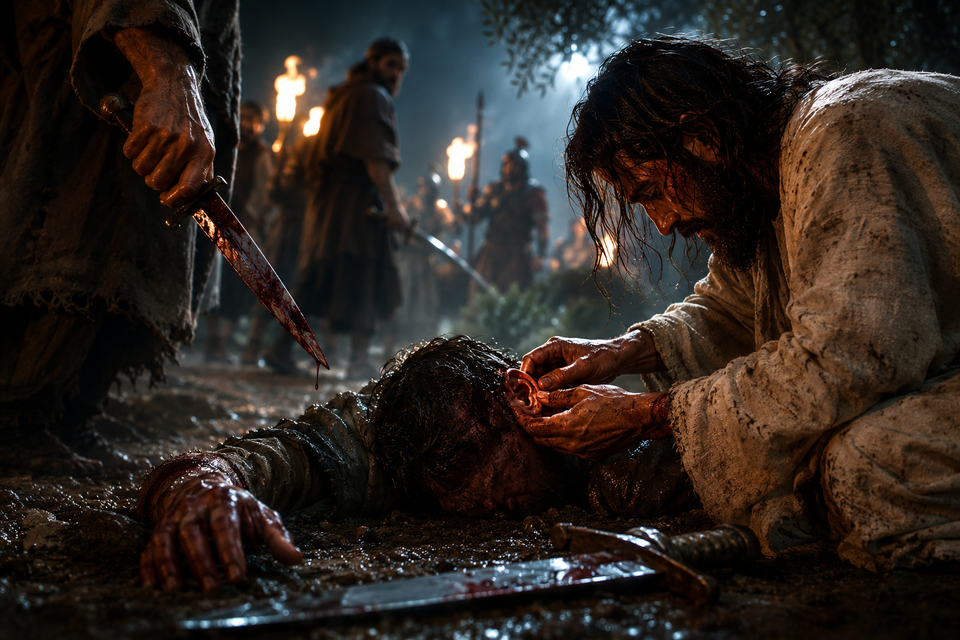
There are two gospels being preached in the garden, and both of them are being preached by men who love God. That may be the most unsettling part of the story. One gospel has a sword in its hand. The other reaches down and touches a wounded ear. One believes something precious is about to be taken away and must be defended. The other has already surrendered everything and therefore has nothing left to protect. Peter cuts the ear off. Jesus puts it back on. And in that moment, the entire distance between religious devotion and the nature of God is exposed.
Peter is not an unbeliever. He is not a casual follower standing at the edge of the crowd. He has left everything to follow Jesus. He has slept on the ground beside Him, eaten meals with Him, watched dead bodies breathe again, seen demons leave, heard the secrets of the kingdom, and stood on a mountain while the glory of another world broke through the skin of the Man he called Lord. Peter knows who Jesus is. He has revelation. He has history. He has loyalty. He has zeal. And he still has a sword.
That should trouble us more than it does.
It is possible to know who Jesus is and still not know what Jesus is like. It is possible to have revelation without transformation. It is possible to spend years near Jesus and still instinctively reach for weapons He never asked us to carry. Peter is sincere when he draws the sword. He believes he is helping. He believes the moment requires action. Something he loves is being threatened, and everything inside him rises to preserve it.
Jesus does the opposite.
He reaches for the man Peter wounded.
There is something almost unbearable about that moment. Jesus is being betrayed. Soldiers have come to arrest Him. Judas has kissed Him. His closest friends are confused and frightened. Within hours He will be beaten, mocked, stripped, falsely accused, and crucified. Yet in the middle of all of it, Jesus notices an ear lying in the dirt.
Peter sees an enemy. Jesus sees a wound.
The difference between them is not that Peter cares and Jesus does not. Peter cares deeply. The difference is that Peter’s love is still entangled with fear. He cannot imagine losing Jesus. He cannot imagine the kingdom continuing if this moment goes badly. He cannot imagine resurrection on the other side of surrender. So Peter does what frightened men have always done. He reaches for control.
Jesus has no need to control the moment because Jesus trusts the Father.
This is the great dividing line between the gospel of self preservation and the gospel of the kingdom. Self preservation is not always obvious. Sometimes it looks like wisdom. Sometimes it sounds like responsibility. Sometimes it carries Bible verses and calls itself discernment. Sometimes it insists that it is only defending what is sacred. But beneath all of its religious language is the same frightened question: What will happen to me if I do not protect myself?
Jesus seems completely free from that question.
Nothing about Him in the garden is frantic. He is not trying to preserve His reputation. He is not attempting to manage public perception. He is not gathering His disciples to develop a strategy. He is not calculating how to survive the night. He has prayed until His sweat became blood, and somewhere in that terrible conversation with the Father, the issue of His life has already been settled.
Not My will.
Yours.
That is why Jesus can heal the ear.
The healing of Malchus is not a random miracle performed on the way to the cross. It is the revelation of a Man who has become completely free from Himself. Jesus can give Himself to the wound of another person because He is no longer preoccupied with what is about to happen to Him.
Peter cannot see the wounded man because Peter is worried about losing something.
Jesus sees him because Jesus has already surrendered everything.
How much damage has been done by people who believed they were defending Jesus? How many ears have been cut off by sincere believers carrying the right revelation with the wrong spirit? How many people can no longer hear the good news because someone wounded them in the name of protecting the truth?
The tragedy is not simply that Peter cut off an ear. The tragedy is that Jesus had to repair the damage done by someone who thought he was helping Him.
That sentence should stay with us.
There is a kind of help Jesus does not want.
There is a kind of defense that contradicts the One we claim to defend. There is a kind of zeal that can confess Jesus as Lord and still behave nothing like Him when pressure comes. Peter knew the correct answer when Jesus asked, “Who do you say that I am?” But when the garden came, Peter discovered that accurate theology had not yet reached the deepest instincts of his body.
The garden always reveals what the classroom cannot.
Anyone can speak about love at the table. Anyone can talk about forgiveness when Judas is not in the room. Anyone can preach surrender when there are no soldiers carrying torches through the darkness. But eventually every disciple enters a garden where what we believe about God collides with what we believe we must do to survive.
And in that garden, the hidden sword becomes visible.
Peter had left his nets years earlier, but there was still something he had not left behind. He had left his occupation. He had left his routine. He had left his former life. But Peter had not yet left Peter.
Eventually, discipleship brings us to that place.
There comes a point where Jesus is no longer asking us to leave possessions behind. He begins asking us to surrender our right to preserve ourselves. Our right to retaliate when wounded. Our right to be understood. Our right to control the outcome. Our right to make sure the people who hurt us suffer enough to satisfy our sense of justice.
The deepest sword is not carried at the waist.
It is carried in the soul.
It is the quiet determination that no one will ever make me feel that powerless again. It is the vow that I will never be humiliated like that again. It is the instinct to strike first, withdraw first, expose them first, defend myself first. We may never touch a physical weapon, but many of us have become highly skilled at cutting off ears.
We know how to use silence as a sword. We know how to use truth as a sword. We know how to use Scripture, distance, sarcasm, influence, and even prayer as ways of punishing people who made us feel threatened.
Then Jesus kneels beside the person we wounded.
And He puts the ear back on.
There may be no more confronting picture of discipleship than watching Jesus heal the person we were certain deserved to bleed.
Jesus does not need Peter to protect Him from His enemies. Jesus wants Peter to learn how to reveal Him to His enemies.
That is an entirely different gospel.
The question is no longer whether we can defeat the people who oppose us. The question is whether opposition can make us become unlike Jesus. The question is whether betrayal can change our nature. Whether rejection can turn love into bitterness. Whether injustice can convince us to pick up a weapon the Lamb never carried.
You cannot make Jesus stop being Jesus.
That is the wonder of the garden.
Arrest Him and He heals. Accuse Him and He refuses to retaliate. Strike Him and He does not become violent. Strip Him and He does not become ashamed. Mock Him and He does not become bitter. Crucify Him and forgiveness comes out of His mouth.
There is nothing you can do to Jesus that will cause Jesus to become unlike His Father.
This is maturity.
Maturity is not the ability to explain the mysteries of God. It is not measured by how much revelation we can articulate or how powerful we appear when the room is filled with worship. Maturity is discovered when someone comes to take something from us and finds that the nature of Christ remains.
Pressure reveals formation.
The garden tells the truth.
Peter reaches for the sword because Peter believes death is the end of the story. Jesus refuses the sword because Jesus knows resurrection is coming.
Perhaps this is the real reason self preservation has such power over us. We do not yet believe deeply enough in resurrection.
We believe in resurrection as a doctrine. We sing about it. We preach it on Easter. We confess that Jesus walked out of the grave. But resurrection has not yet entered the places where we panic about loss.
If I truly believe in resurrection, I do not have to preserve every version of my life.
I can allow the Father to close doors. I can release relationships I cannot control. I can survive being misunderstood. I can forgive without demanding repayment. I can surrender the future I imagined. I can let something die without standing over the grave trying to force it to breathe again.
Resurrection means I can trust God with what surrender costs me.
Jesus is free because Jesus trusts the Father.
That is the secret beneath everything happening in the garden.
The opposite of self preservation is not passivity. It is not weakness. It is not pretending that evil does not exist. The opposite of self preservation is trust.
Jesus can refuse the sword because He trusts the Father. Jesus can surrender to arrest because He trusts the Father. Jesus can walk toward Golgotha because He trusts the Father. Jesus can allow His reputation to be destroyed, His body to be broken, and His life to be poured out because He believes the Father can be trusted beyond the point where obedience becomes death.
Peter loves Jesus, but Peter does not yet trust the Father like Jesus does.
That is why Peter fights.
Fear always needs a sword.
Trust can open its hands.
The journey of discipleship is the long and painful transformation from one man into the other. We begin as Peter, following Jesus while still carrying the weapons that helped us survive before we met Him. We love Him. We believe in Him. We would die for Him, or at least we think we would. But then the garden comes, and we discover that we are more willing to kill than to die.
Jesus does not abandon Peter there.
That may be the most beautiful part.
Jesus heals the ear, tells Peter to put away the sword, and keeps walking toward the cross. He knows Peter will deny Him before sunrise. He knows Peter will collapse beneath the weight of his own fear. He knows Peter is not yet the man he believes himself to be.
And Jesus keeps him.
Because Jesus knows resurrection is coming for Peter too.
One day, the man who drew the sword will stretch out his own hands. One day, Peter will no longer be governed by the frantic need to preserve himself. Grace will finish its work. The Spirit will enter the places fear once occupied. The resurrection of Jesus will become more than something Peter witnessed. It will become the reality that rearranges the way Peter lives and dies.
This is our hope.
Jesus is patient with people who still carry swords.
He will lead us into gardens where we discover them. He will allow moments that expose how deeply self preservation still governs our decisions. He will show us the wounds we have created while trying to defend what we thought was sacred.
And then He will teach us to heal ears.
He will form in us the kind of life that can remain tender in the presence of enemies. The kind of life that can be betrayed without becoming a betrayer. The kind of life that can suffer without making others suffer. The kind of life that is so convinced of resurrection that it no longer has to fight desperately to keep everything alive.
There are two gospels in the garden.
One is terrified of losing.
The other has already surrendered.
One reaches for the sword because it cannot imagine life on the other side of death.
The other reaches for the wound because resurrection has made self preservation unnecessary.
Peter cuts off the ear.
Jesus puts it back on.
And somewhere between those two actions is the entire journey of discipleship.
We spend years asking Jesus to teach us how to fight for Him.
Perhaps Jesus is trying to teach us how to become so free from ourselves that we no longer need to.
Perhaps the greatest evidence that Christ has formed His life within us is not that we have become more powerful defenders of the faith, but that the people standing against us can finally see what the Father is like.
The garden is coming for every one of us.
And when it comes, the deepest question will not be whether we know who Jesus is.
The deepest question will be whether, after all these years of following Him, we have finally become like Him.
If you feel led to partner with what God is doing through this ministry, we invite you to sow into this work as the Spirit leads. Your generosity helps us continue to share His love and truth with others. There is no obligation only an opportunity to join in what God is building. Thank you for considering being a part of this journey.
Member discussion