Offense Cannot Father Union
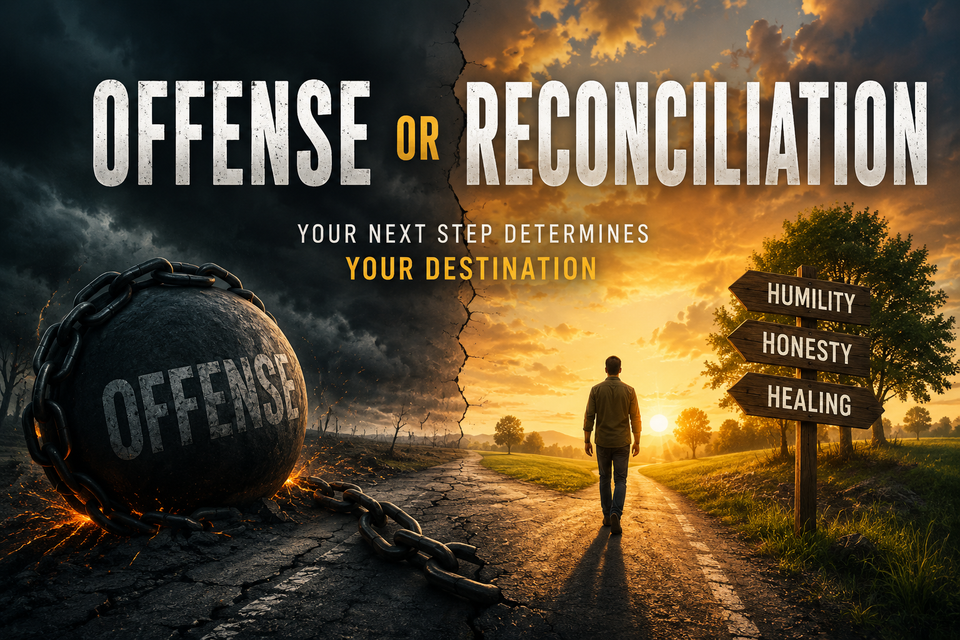
As long as offense remains the vehicle, distance will always be the destination. You cannot drive toward reconciliation in a car powered by resentment and expect to arrive at intimacy. It is impossible. Offense always promises protection, but what it actually produces is isolation. It convinces you that staying guarded is wisdom, that keeping score is discernment, and that withholding vulnerability is strength. But the truth is, offense is one of the most deceptive prisons a human heart can inhabit, because the bars are built from justified pain.
Reconciliation cannot be built on unresolved offense. It cannot be sustained by passive aggression, quiet contempt, selective honesty, or emotional distance disguised as maturity. If offense remains unaddressed, every attempt to come closer only creates the illusion of progress while secretly widening the gap. You may have conversations. You may exchange apologies that never reach the heart. You may even reestablish proximity. But proximity is not the same thing as reconciliation. Being near someone is not the same as being healed with them.
Because reconciliation is not merely about occupying the same space. Reconciliation is about the restoration of trust, the reestablishment of honor, and the renewal of connection at the level of the heart.
And offense is violently opposed to all of it.
The dangerous thing about offense is that it often feels righteous. It rarely introduces itself as bitterness. It usually comes dressed as self protection. It says, “I am just being careful.” It says, “I have boundaries now.” It says, “I am just not going to let that happen again.”
Now hear me clearly. Wisdom is necessary. Boundaries can be healthy. Discernment matters. But there is a profound difference between healthy boundaries and fortified bitterness.
One protects peace.
The other protects pain.
One creates room for healing.
The other ensures wounds remain untouched.
Jesus said in Luke 17:1, “It is impossible that no offenses should come.”
That means offense will present itself. Opportunity for hurt is inevitable in human relationships. If you live long enough, love deeply enough, serve faithfully enough, and stay connected to people long enough, someone will disappoint you. Someone will misunderstand you. Someone will mishandle your trust. That is not the issue.
The issue is what you do when offense arrives.
Do you enthrone it?
Do you nurse it?
Do you build an identity around it?
Because unresolved offense has a way of becoming theology. It becomes the lens through which you interpret everything. Suddenly every conversation is filtered through suspicion. Every silence feels intentional. Every correction feels like rejection. Every delay feels personal.
Offense distorts perception.
Jesus said in Matthew 6:22, “The lamp of the body is the eye. If therefore your eye is good, your whole body will be full of light.”
A wounded perspective creates a darkened interpretation. When offense governs your sight, even love can look like attack.
And that is why reconciliation becomes impossible while offense remains unhealed.
Because reconciliation requires humility.
Humility says, “I may not be seeing this clearly.”
Offense says, “I already know exactly what they meant.”
Humility says, “Help me understand.”
Offense says, “I do not need explanation.”
Humility creates conversation.
Offense creates verdicts.
And some people have become so committed to their verdict that no amount of truth can penetrate the courtroom they built in their own heart.
That is dangerous.
James 1:19 through 20 says, “Let every man be swift to hear, slow to speak, slow to wrath. For the wrath of man does not produce the righteousness of God.”
Human anger does not produce divine outcomes.
Read that again.
Your justified anger cannot produce what only surrendered hearts can build.
You cannot bully your way into healing.
You cannot punish your way into intimacy.
You cannot manipulate your way into restoration.
Healing requires humility, honesty, and a willingness to lay offense down.
That does not mean pretending nothing happened.
Forgiveness is not denial.
Reconciliation is not pretending betrayal did not wound you.
No.
Healing requires truth.
Real truth.
Not edited truth.
Not emotionally curated truth.
Not strategically released truth.
Honesty.
The kind that says, “This hurt me.”
The kind that says, “I felt abandoned.”
The kind that says, “I interpreted your actions this way, but I need clarity.”
The kind that refuses to weaponize silence.
Because silence can be just as manipulative as accusation.
Some people do not scream.
They withdraw.
Some people do not confront.
They emotionally disappear.
Some people never raise their voice, but they master the art of distance.
And distance becomes punishment.
But punishment has never healed a relationship.
Only truth soaked in love can do that.
Ephesians 4:31 through 32 says, “Let all bitterness, wrath, anger, clamor, and evil speaking be put away from you, with all malice. And be kind to one another, tenderhearted, forgiving one another, even as God in Christ forgave you.”
Notice the language.
Put it away.
Scripture does not say manage bitterness.
It does not say justify bitterness.
It says put it away.
Why?
Because bitterness contaminates everything it touches.
A bitter person does not just struggle with one relationship. Bitterness begins to leak into perspective, prayer, worship, trust, and identity.
Bitterness makes intimacy with God feel distant because offense toward people often hardens the same heart meant to stay tender before the Lord.
You cannot remain emotionally armored toward everyone around you and somehow stay soft before God. The heart does not compartmentalize that cleanly.
And some people keep asking why they feel disconnected spiritually while feeding offense relationally.
Jesus addressed this in Matthew 5:23 through 24.
“If you bring your gift to the altar, and there remember that your brother has something against you, leave your gift there before the altar, and go your way. First be reconciled to your brother, and then come and offer your gift.”
That is stunning.
Jesus prioritized reconciliation so highly that He connected it to worship.
Meaning unresolved relational fracture matters to heaven.
Now obviously reconciliation requires mutual participation. You cannot force healing with someone committed to dysfunction. Romans 12:18 says, “If it is possible, as much as depends on you, live peaceably with all men.”
That phrase matters.
If it is possible.
Because sometimes it is not.
Sometimes the other party is unwilling.
Sometimes they are committed to misunderstanding.
Sometimes offense has become part of their identity.
And if they are unwilling to step out of that posture, every attempt to come closer will only create the illusion of progress while driving everyone further apart.
You cannot reconcile with someone who needs the wound more than they want the healing.
That sounds severe, but it is true.
Some people derive identity from being wronged.
It gives them moral superiority.
It gives them narrative control.
It gives them emotional leverage.
And surrendering offense would require surrendering the identity built around pain.
That is why healing feels threatening to some people.
Because healing would require humility.
It would require admitting they may have misread something.
It would require acknowledging their own contribution.
It would require laying down the emotional power offense provides.
And not everyone is ready for that.
But hear me.
Your call is not to control their posture.
Your call is to guard your own heart.
Proverbs 4:23 says, “Keep your heart with all diligence, for out of it spring the issues of life.”
Guarding your heart does not mean hardening it.
Those are not the same thing.
Guarding is stewardship.
Hardening is fear.
One keeps your heart healthy.
The other makes your heart inaccessible.
And there are people who think they are healed because they no longer feel pain, when in reality they just no longer feel.
That is not healing.
That is numbness.
The Kingdom does not call us into emotional anesthesia.
It calls us into wholeness.
Wholeness can tell the truth without hatred.
Wholeness can establish boundaries without contempt.
Wholeness can forgive without denying reality.
Wholeness can love without surrendering wisdom.
But none of that happens while offense remains enthroned.
So the question is not whether you were hurt.
The question is what your hurt has been allowed to build.
Has it built wisdom?
Or suspicion?
Has it built maturity?
Or emotional distance?
Has it built compassion?
Or cynicism?
Because whatever offense is building in you will eventually determine what you are capable of receiving from others.
And from God.
Lay it down.
Not because what happened was acceptable.
But because carrying offense is too expensive.
It costs peace.
It costs intimacy.
It costs clarity.
It costs tenderness.
It costs spiritual sensitivity.
And eventually, it costs the very reconciliation you say you want.
As long as offense remains the vehicle, distance will always be the destination.
But the moment humility takes the wheel, honesty becomes the road, and grace becomes the atmosphere, healing stops being a fantasy and starts becoming a possibility.
If you feel led to partner with what God is doing through this ministry, we invite you to sow into this work as the Spirit leads. Your generosity helps us continue to share His love and truth with others. There is no obligation only an opportunity to join in what God is building. Thank you for considering being a part of this journey.
Member discussion