Holy Heartbreak
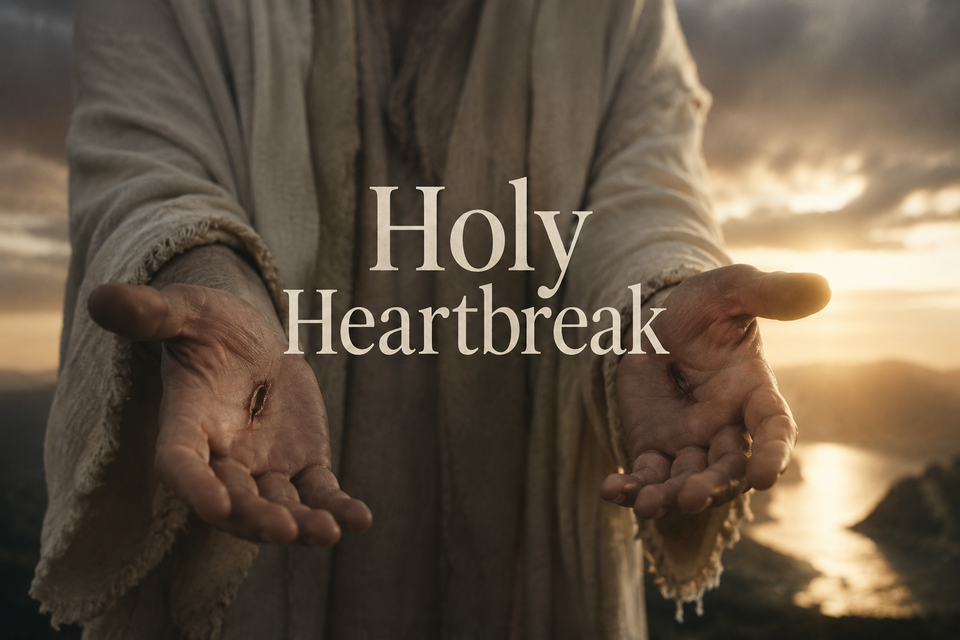
Thomas gets one of the most unfair nicknames in all of scripture.
History has remembered him as Doubting Thomas, as if one moment of brutal honesty should define an entire life of devotion. As if one wounded sentence should erase years of loyalty. As if grief should be interpreted as rebellion.
But I do not believe Thomas was a doubter.
I believe Thomas was heartbroken.
There is a difference.
Doubt says, “I do not believe you are who you say you are.”
Heartbreak says, “I believed so deeply that I do not know how to survive this loss.”
That is Thomas.
And if we are honest, many of us have been there.
We have heard this story preached through the lens of correction. Thomas becomes the cautionary tale. The man who missed the meeting. The disciple who demanded proof. The one Jesus had to straighten out.
But what if we have completely misunderstood him?
What if Thomas was not standing in unbelief.
What if he was standing in shattered love.
In John 20, the disciples tell Thomas they have seen the Lord. Their excitement is overflowing. Resurrection has invaded the room. Hope is alive again.
And Thomas says something that generations have used against him.
“Unless I see in his hands the mark of the nails, and place my finger into the mark of the nails, and place my hand into his side, I will never believe.”
That sounds harsh if you read it with cold eyes.
But read it through grief.
Read it through trauma.
Read it through the devastation of watching the man you gave your life to be murdered.
Thomas is not speaking as a skeptic.
He is speaking as a man whose heart has been ripped open.
This is the language of someone who loved deeply enough to be destroyed.
People forget Thomas had already proven his courage.
When Jesus was preparing to go to Judea, where danger was waiting, it was Thomas who said, “Let us also go, that we may die with him.”
That is not the confession of a detached observer.
That is the confession of a loyal son.
That is a man who had already counted the cost.
Thomas was not halfway in.
Thomas was all the way in.
Which is exactly why the pain was so severe.
The ones who love the deepest often ache the hardest.
You cannot experience profound disappointment unless you first carried profound expectation.
Thomas had believed Jesus would change everything.
He had watched blind eyes open.
He had seen impossible things become normal.
He had built an internal world around the certainty that Jesus was the one.
And then he watched Rome crucify hope.
He watched blood fall.
He watched breath leave.
He watched silence replace promise.
Do we really think his response should have been emotionally polished?
Do we really expect tidy theology from a traumatized heart?
No.
Thomas is not doubting.
Thomas is grieving.
And grief has a vocabulary.
Sometimes grief says irrational things.
Sometimes grief builds walls.
Sometimes grief says, “I cannot survive believing again unless I know this is real.”
That is not rebellion.
That is self protection.
Thomas is saying, “I cannot let hope deceive me again.”
And here is what wrecks me.
Jesus does not shame him for it.
That alone should change the way we see God.
Jesus could have arrived with correction.
He could have said, “Thomas, after everything you saw, how dare you.”
He could have humiliated him in front of the others.
He could have demanded apology.
Instead, Jesus comes straight toward the wound.
This is the beauty of the Christ we serve.
He is not intimidated by honest pain.
He is not threatened by wounded questions.
He does not recoil from broken people trying to make sense of impossible disappointment.
He walks right into the room and addresses Thomas specifically.
“Put your finger here. See my hands. Put out your hand, and place it in my side.”
Think about that.
Jesus did not merely offer evidence.
He offered his scars.
This is not just proof of resurrection.
This is the revelation of divine tenderness.
Thomas said, “I need to see the wounds.”
And Jesus said, “Come closer.”
What kind of King does that?
What kind of God responds to wounded honesty with invitation instead of rejection?
The religious spirit says, “Hide your questions.”
Jesus says, “Bring them here.”
Religion says, “Clean up your emotions before approaching God.”
Jesus says, “Come exactly as you are.”
Religion says, “Faith means never struggling.”
Jesus says, “Touch the scar.”
I think Thomas needed the wounds because wounds are honest.
A resurrected Jesus without scars might have felt disconnected from the suffering Thomas witnessed.
But the scars told the story.
The scars said, “Yes, the pain was real.”
The scars said, “Yes, death happened.”
The scars said, “What broke your heart broke mine too.”
This is critical.
Thomas did not need abstract theology.
He needed connection.
He needed to know the Jesus standing before him was the same Jesus who suffered.
Because pain changes you.
Loss changes you.
Grief changes you.
And when you have walked through devastating disappointment, you do not want shallow answers.
You want authenticity.
You want something real enough to hold.
Thomas wanted the wounds because the wounds proved continuity.
This was not a replacement Jesus.
This was not spiritual theater.
This was the same one.
Still marked.
Still bearing the evidence of love.
And perhaps that is why this story resonates so deeply with so many of us.
Because we know what it feels like to stand where Thomas stood.
To believe for healing that did not come.
To pray prayers that seemed unanswered.
To expect breakthrough and experience silence.
To trust God for something precious and watch it die anyway.
And somewhere in that ache, faith gets complicated.
Not because we stopped loving Jesus.
But because we loved him enough for disappointment to matter.
That is Thomas.
He is not distant.
He is devastatingly familiar.
And Jesus does not exile him.
Jesus meets him.
This may be the word somebody needs right now.
Your heartbreak has not disqualified you.
Your questions have not offended heaven.
Your wounded honesty has not pushed Jesus away.
If anything, your pain may be the very place he intends to reveal himself most intimately.
Because resurrection does not erase scars.
It redeems them.
That is one of the most profound mysteries of the gospel.
Jesus could have risen without marks.
Yet he chose to keep them.
Why?
Because healed wounds become testimony.
Because scars preach.
Because the places that looked like defeat became the evidence of victory.
Thomas wanted to touch what death had done.
And in doing so, he encountered what resurrection had accomplished.
This is why I refuse to reduce him to a doubter.
He was a lover in pain.
He was a faithful man navigating catastrophic disappointment.
He was someone trying to reconcile what he knew about Jesus with what he had experienced.
And when revelation finally came, Thomas gave one of the most profound confessions in scripture.
“My Lord and my God.”
The so called doubter became the declarer.
The wounded one became the worshiper.
The man who needed to touch scars ended up touching divinity.
Do you see it?
Jesus was never trying to embarrass Thomas.
He was restoring him.
And maybe he is doing the same with you.
Maybe the story is not about condemnation for struggling.
Maybe it is about the extraordinary kindness of a Savior who knows how to meet shattered hearts.
Maybe your demand for authenticity is not the enemy of faith.
Maybe it is the doorway to deeper encounter.
Not every person wrestling is rebellious.
Not every question is unbelief.
Not every pause is abandonment.
Sometimes it is heartbreak learning how to breathe again.
Thomas teaches us that Jesus can handle that process.
And perhaps the church should learn from Christ here.
Too often we shame people for asking hard questions while Jesus is offering his wounds.
Too often we label people as doubters when heaven sees sons in pain.
Too often we demand polished faith from people still bleeding internally.
But Jesus is gentler than our systems.
Kinder than our assumptions.
More secure than our religious frameworks.
He can handle your honesty.
He can handle your ache.
He can handle the version of you that says, “I want to believe, but I need to touch something real.”
And the miracle is this.
He still comes close.
So no, I do not believe Thomas was just a doubter.
I believe he was a man who loved Jesus so deeply that crucifixion shattered him.
I believe he was a wounded disciple trying to protect his heart from another collapse.
I believe he needed to see the holes because love had left holes in him too.
And I believe Jesus understood that completely.
If you feel led to partner with what God is doing through this ministry, we invite you to sow into this work as the Spirit leads. Your generosity helps us continue to share His love and truth with others. There is no obligation only an opportunity to join in what God is building. Thank you for considering being a part of this journey.
Member discussion