The Loneliness Epidemic and the Hunger for Real Belonging
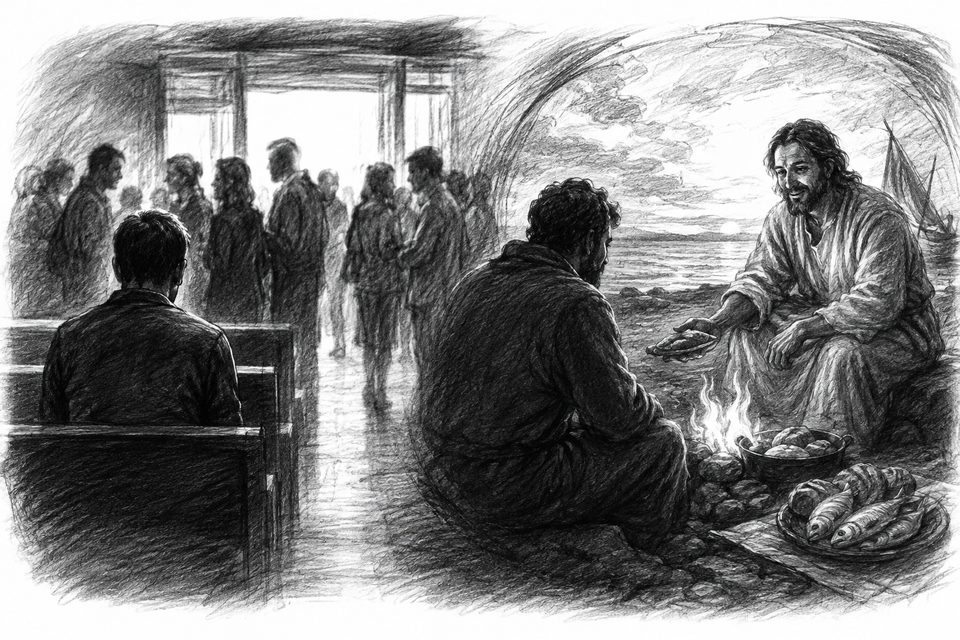
There is a kind of loneliness that is difficult to admit because your life does not look lonely.
Your phone keeps lighting up. People know your name. There are places to be this week. Maybe you are part of a church, a workplace, a group of friends. You can spend an entire Sunday morning talking to people and still sit in the car afterward with the strange feeling that nobody really saw you.
Years ago, I watched a man stand alone in a church lobby for nearly ten minutes, turning the same paper coffee cup around in his hands. Every few seconds he would look toward the doors as if someone might be coming. Eventually he threw away a cup I am almost certain was still full and walked out.
I never knew what he was waiting for.
Maybe nothing.
But I have thought about him more than once.
Loneliness hides in ordinary places like that. It is possible for people to know what you do, what you believe, what you are good at, even the broad outline of what you are struggling with, and still not really know you.
There is a difference between being recognized and being received.
That difference matters to Christians and nonbelievers alike. Somewhere beneath it is the same human question: Where can I be known without having to remain impressive?
Contact Is Not Communion
Modern technology has given us remarkable ways to reach one another. Families separated by oceans can see each other’s faces. Old friendships can survive distance. Someone isolated in a small town can find people who understand an experience nobody nearby seems to understand.
I am grateful for that.
But we have also become very good at maintaining contact while remaining strangely unpracticed at sharing a life.
You can watch a friend’s holiday while having no idea that their marriage is falling apart. You can receive a hundred birthday messages and still hesitate when the doctor says something frightening because you are not sure who you are allowed to call.
That is what contact cannot give us by itself.
Modern life keeps moving us too. We leave home for university, move again for work, move again because the rent changed or because somebody we love lives somewhere else. Sometimes moving is exactly the right decision. Still, roots do not pack neatly into cardboard boxes.
There is something powerful about being known by people who remember who you were before you became whoever you are now. Maybe they remember your parents, your first terrible job, or the year you tried to grow your hair long and everyone was too polite to tell you it was not working.
Those relationships are difficult to manufacture because they were not formed by finding the perfect match. They accumulated through ordinary years together.
When Belonging Gets Expensive
A crowd can make you feel less alone for an evening, and a network can help you accomplish something. Community begins revealing itself when weakness enters the room.
Eventually the edited version of you becomes impossible to maintain. Someone discovers that you are more complicated than they first imagined, and now both of you have to decide what kind of relationship this actually is.
This does not mean tolerating abuse. Love needs truth, and healthy relationships need boundaries. But we have sometimes confused boundaries with arranging our lives so that nobody is ever allowed to disappoint us.
Anyone you know deeply enough will eventually disappoint you.
You will disappoint them too.
Can truth be spoken without exile?
Can weakness appear without becoming gossip?
Can disagreement survive without becoming separation?
Can I fail and still have a place here?
Those questions expose something important. Shared interests may help people meet, but they cannot carry the full weight of belonging. At some point community requires a commitment deeper than compatibility.
The Strange Loneliness of Church
Church can be one of the loneliest places to feel lonely because there is a particular shame in feeling unknown in a room where everyone keeps calling one another family.
People learn how to function inside that contradiction.
They attend, serve, smile, and eventually become skilled at giving an answer to “How are you?” that is honest enough to sound sincere without being honest enough to make anybody late for lunch.
Sometimes years pass before anyone realizes that the person sitting nearby has been quietly disappearing.
Churches can become very good at organizing people without actually joining their lives. Groups, studies, conferences, teams, and events can all serve good purposes, but none of them automatically creates communion. You can sit in someone’s living room every Tuesday discussing Scripture and still never tell the truth.
We also tend to be more comfortable with pain once it has acquired an ending. We know what to do when somebody says the marriage was restored or the child came home.
Unresolved suffering makes the room quieter.
There are people whose prayers still do not have endings. There are people who love God and cannot find Him in what happened to them. They do not always need an explanation. Sometimes they need another person who is willing to remain in the room without trying to make the mystery smaller.
Maybe We Are Homesick
The more I think about loneliness, the less convinced I am that it is only a social problem.
Some loneliness requires ordinary courage. Call the friend. Invite someone over. Learn the neighbor’s name. Stay around after church instead of disappearing immediately.
There is no mystical substitute for knocking on someone’s door.
But I think the ache reaches deeper.
Christianity makes a remarkable claim about what existed before us.
Before humanity.
Before friendship.
Before marriage, churches, cities, and dinner tables.
God was already communion.
Christians call this the Trinity: Father, Son, and Spirit. We have spent centuries trying to speak carefully about this mystery because no human language can contain God neatly. But there is something astonishing at its center.
God has never been lonely.
Love did not begin when humanity appeared. God did not create because He needed somebody to fill an empty room.
Before creation learned the word love, love already existed within the life of God.
Then Scripture says that human beings were made in the image of this God. Suddenly our hunger to know and be known begins to look like more than an emotional preference. We were made for communion, and perhaps that is why isolation can wound us so deeply.
The ancient Christian story begins with human beings naked and unashamed. Then everything fractures, and one of the first things humanity does is hide.
We have found more sophisticated hiding places since then. Some of us hide inside achievement. Some hide behind humor or competence. Religion itself can become a hiding place when knowing the right language becomes easier than allowing ourselves to be known.
Still, something in us wants to come out.
Perhaps we are homesick for something we were made for but have never fully known.
You May Not Share the Faith
You may not share the faith, but you already know this hunger is real.
You probably know what it is like to be with someone who makes your body relax a little. They do not require you to be interesting. Silence does not become an emergency. You can finish the meal without feeling as though you have been auditioning.
Maybe Christianity feels distant to you. Maybe Christians themselves gave you good reasons to keep your distance. You do not need to pretend otherwise for the sake of this argument.
I would only ask you to remain curious about the hunger.
Being known seems to matter to us in a way that is difficult to dismiss as mere preference. There is something about love, presence, and being received that seems bound up with becoming fully human.
Perhaps the hunger is telling the truth about us before we know what we think about God.
Breakfast by the Fire
This is one reason Jesus remains so compelling to me.
He keeps finding people in hiding. He eats with people whose presence damages His reputation. He touches people others avoid. He lets uncertain people remain near enough to keep asking their questions.
Then one of His closest friends fails Him publicly.
Peter denies knowing Him.
When association with Jesus becomes dangerous, Peter insists that he does not know the man.
After the resurrection, Peter comes ashore.
There is a fire.
Bread.
Fish.
And Jesus has made breakfast.
I love that detail because Jesus does not begin with a lecture. Peter has failed spectacularly, and there will be a conversation about that failure. But first there is food.
Before the conversation about failure comes a meal.
There is still a place for Peter near the fire.
I think about that scene whenever Christians talk about belonging. If belonging were built on performance, Peter’s place would have been gone. Instead, Jesus meets a ashamed friend on a beach and feeds him.
This is not a God standing at a distance waiting for broken people to become presentable.
This is God meeting us on the shore.
The Christian claim is that Jesus does more than make lonely people sociable. In Christ, humanity is being brought back into communion with God. Forgiveness is not merely the cancellation of a debt. It opens into fellowship.
And the church is supposed to be what happens when people who have been received like that begin receiving one another.
When Communion Gets an Address
If that is true, Christian community cannot remain an idea. Eventually it has to become visible in ordinary places.
It may be an older woman noticing that a young mother has missed church for two weeks and calling without making her feel guilty. It may be somebody sitting in a hospital after they have run out of useful things to say, or a recovering addict being invited to dinner without becoming the evening’s ministry project.
Sometimes theology looks like lasagna on a doorstep.
Years ago, after a difficult week, someone brought food to a friend’s house in an old casserole dish with a cracked plastic lid that had to be held on with two rubber bands. Nobody had remembered to label the dish. Nobody had written a profound note.
They just knew dinner needed to happen.
I think there is something deeply Christian about that kind of unremarkable love.
Real community will often be inconvenient. It interrupts schedules. It requires remembering things you would otherwise forget. Sometimes it means listening to a story you have already heard because the person telling it needs to tell it again.
None of this is less spiritual than what happens during a church service. It is simply what belief begins to look like when it enters a kitchen, a hospital room, or a Tuesday night.
Leave the Light On
To the church, there is a challenge here.
We cannot keep using the word family if what we mainly offer people is attendance.
If God has welcomed us into His life, that welcome should eventually become visible in who gets invited into ours, who gets noticed when they disappear, and whether people in pain can tell the truth without becoming a problem to solve.
And to the lonely reader, whether you believe in God, walked away from church years ago, or have never believed any of this, do not make peace too quickly with being unknown.
You do not need twenty new friends.
Start with one honest conversation. Accept an invitation you would normally decline. Let someone trustworthy see a part of your life you normally keep edited.
Belonging usually develops so quietly that you do not notice the exact moment it happens.
One day you are a guest.
Then, months later, you are standing in somebody’s kitchen while they are upstairs changing the baby. You open the wrong drawer looking for a spoon. The dog is asleep against your shoe. There is a grocery list on the refrigerator and somebody has written “toilet paper” twice.
Nobody is entertaining you.
Nobody is trying to make the evening meaningful.
And somehow that is the moment you realize something has changed.
You are no longer visiting.
Outside, it has gotten dark.
Inside, nobody is watching the door.
If this ministry has encouraged your walk with Christ and you feel led by the Lord to partner with what He is doing, we invite you to prayerfully consider supporting this work. Every gift helps us continue sharing the truth of God’s Word and the hope of the gospel with people around the world.
There is never any obligation to give, only an opportunity to participate in what God is doing. We are deeply grateful for your prayers, your encouragement, and, if the Lord leads, your generosity.
You can give here: Awaken Ministries Donation Page
Member discussion