Why Am I Still Empty When I Have What I Thought I Wanted?
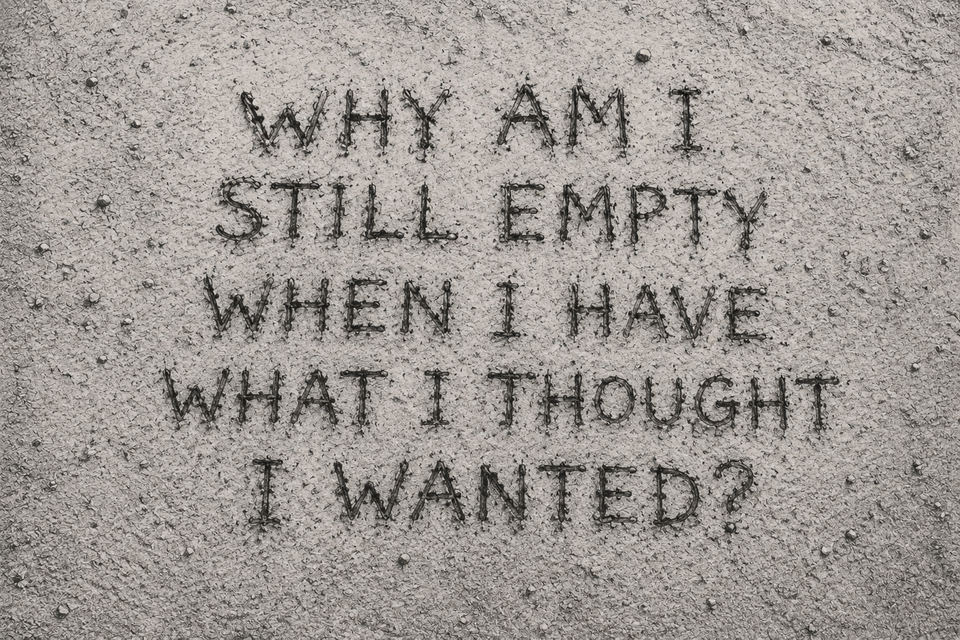
There is an emptiness that becomes harder to explain once life starts giving you what you asked for. When you do not have what you want, the ache has somewhere obvious to point. You need more money. You want someone to love you. You want work that means something, a home that feels like yours, some freedom, some evidence that your life is moving. It is easy to believe the unsettled feeling inside you belongs to the missing thing. Then some of those things arrive. Not all of them, and rarely in the form you imagined, but enough that an earlier version of you would look at your life with disbelief. For a while you feel relief. Then ordinary life returns, and eventually you notice the restlessness has returned with it.
This is where people often become frightened of their own ingratitude. You have something you prayed for, worked for, perhaps cried over, and now you are standing inside it wondering why you do not feel the way you promised yourself you would feel. So you begin searching again. Maybe the relationship is wrong. Maybe you need to move. Maybe you have lost your purpose. Sometimes one of those things is true. But sometimes nothing outside you is asking to be rearranged. You may simply have given something in the world a responsibility it could never carry.
We rarely want only what we say we want. Money can become safety long before it becomes currency. Success can carry the hope that somebody will finally look at us differently. Being loved can become evidence in a private trial about whether we are worth loving. Even healing can turn into a bargain where we promise ourselves that one day, after enough work, we will become easier to inhabit. We ask these things to do too much.
Something strange happens when the thing arrives. For a while, the wanting stops. Then the mind adjusts. What once felt extraordinary becomes part of the furniture of your days, and another desire begins forming somewhere at the edge of your attention. We usually assume the peace disappeared because we need something else. I am not sure that is always true. Perhaps, briefly, we simply stopped leaning away from where we were.
Picture a Saturday morning in a grocery store. You are standing under fluorescent lights with a box of Honey Nut Cheerios tucked under your arm because you forgot to get a basket. The produce section smells faintly of wet floor cleaner. A child nearby is dragging the toe of one red sneaker against the tile while his mother keeps saying, “We are not buying that today.” You reach into your pocket and feel the edge of a key that belongs to the home you once wondered whether you would ever be able to afford. For no particular reason, you notice it. Somebody squeezes past you looking for bananas, and you move out of the way.
Nothing has to happen next.
Much of what we once wanted eventually becomes mixed into scenes like that. The blessing does not disappear. It becomes ordinary enough to live inside. The life you imagined becomes the life in which you buy cereal, forget what else you came for, get annoyed in traffic and think about dinner.
This is why you have to become careful with emptiness. There are times when leaving is necessary, when the relationship really is over, when the work has hollowed you out, when your body is telling you something your mind keeps refusing to hear. There are also times when movement is simply how you avoid being where you are. Learning the difference takes honesty, and honesty does not always make the answer obvious.
What do you do when you genuinely cannot tell whether the emptiness is calling you forward or exposing your inability to stay?
I don’t know that there is a clean answer.
It helps to notice what you are asking the next thing to do. Desire itself is not the enemy. Wanting belongs to being alive. The future becomes a problem when we load it with promises it cannot keep. We tell ourselves rest will come after the next accomplishment, or that another person’s love will finally quiet an old doubt. Maybe sometimes it does quiet it, at least for a while. I don’t want to pretend every desire is secretly avoidance either. Some things really are missing. Some rooms should be left. There are hungers worth trusting and others that have been lying to us for years, and sometimes they speak in exactly the same voice and you stand there trying to tell which one is which and honestly…
Spirituality does not automatically make this easier. Sometimes it gives the same restlessness more respectable language. We try to become present, healed, awake. There is another wound to understand, another pattern to release. None of that work is meaningless. But your inner life can become a place where something is always under repair.
God can get pulled into that project too.
We tend to imagine the absence of a certain feeling as the absence of God. If prayer feels dry or certainty begins to thin, we assume something sacred has gone missing. Sometimes what has disappeared is only our expectation of how God should feel.
The word God can itself become a way of ending the question too early. We name the mystery and then behave as though naming it means we understand it. Theology matters because ideas about God shape actual lives. But if God is God, our language is never going to hold all that the word is trying to name.
Union is one of those words that needs care. It can sound as though the goal is to disappear into God. Communion gives us a different picture. Love leaves room for the beloved to remain a person. We remain creatures receiving life rather than becoming its source.
Your body already knows something about this.
Hold your breath for a little while and the body becomes remarkably uninterested in your theories of independence. Your chest tightens. The throat changes. Eventually you open your mouth and receive what was outside you as the condition for continuing to be alive. Air crosses the boundary we call the body and becomes part of what keeps that body here. You do this thousands of times a day, usually without noticing.
Theology should be able to survive something as ordinary as breathing.
You are not the source of your own existence. You did not arrange your arrival here. You participate in sustaining your life, but underneath that effort is a dependence you never outgrow. For hours every night you stop consciously managing yourself, and your heart keeps beating. Your lungs continue their work in the dark.
Calling the source of being God does not explain respiration, and it should not. God is not a word pasted over whatever science has not explained yet. We understand a great deal about lungs. The stranger question is why there is anything here to breathe at all.
Union does not require pretending that you and God are identical. There remains the fact that you did not give yourself existence and yet have never known a moment outside existence being given. I do not know where a person would stand to observe that from the outside.
This changes how you can approach emptiness. You can remain near it for a while before doing something about it. Sometimes what appears is grief or boredom. You may discover that ambition has been carrying an old need to become undeniable. Other times what you find is much less interesting. Resentment. Jealousy. The wish that somebody would notice how hard you are trying.
Leave it ordinary.
Some pain is simply painful. Some fears are stubborn. Not everything inside you needs to be turned into a lesson.
This is where theology begins touching ordinary life. If relationship with God belongs only to the calmer, healed version of you, then most of your actual days become waiting rooms. Your life is happening now, including the parts that do not look spiritual. Anger can be present while you pray. Doubt can sit at the table with love.
Before you reach toward God, there is already breath.
That sentence can become another pretty spiritual idea, so forget the sentence and notice the next breath instead. Feel where it enters. Notice the small movement somewhere in your chest or stomach. You do not have to call it sacred. You do not have to feel grateful.
It came anyway.
Then another question begins appearing. Who exactly is the person we keep trying to fill?
We tend to imagine a solid self somewhere inside us, a private room waiting for the world to bring enough furniture. So we carry things toward it. Love, money, achievement, experience, praise, knowledge, religion. Still the room feels unfinished. Yet when you try to locate this self clearly, you find a body that has never stopped changing, memories that are less reliable than you would like, thoughts that arrive without invitation, habits learned from other people, a name somebody gave you before you knew what a name was.
You are real, though perhaps less self contained than you imagine. Your language came from other people. Food becomes tissue. Air enters blood. People you love alter the way you think, sometimes years after they are gone. You wake into a world you did not build. There may be a half empty bottle of Heinz ketchup on the refrigerator door.
There is still a life to live after seeing this. Bills remain bills. Relationships require difficult conversations. You may need to leave the job, move, apologize, begin again. Understanding emptiness will not make those decisions for you.
And there will be days when none of this helps much.
You will wake restless. Something you were grateful for last month may irritate you this month. You may understand comparison perfectly and still compare. Knowing something does not guarantee you will live like you know it.
When that happens, return to whatever is actually in front of you. Not because the present contains a secret answer. It is simply where your life is taking place. Sometimes it will feel peaceful. Sometimes it will be boring. Sometimes it will still feel empty.
And maybe you are back under those fluorescent lights with the box of Honey Nut Cheerios tucked under your arm. The produce section still smells faintly of wet floor cleaner. The child is still dragging the toe of one red sneaker against the tile while his mother says, “We are not buying that today.”
Your hand is in your pocket.
The edge of the key is still there.
If this ministry has encouraged your walk with Christ and you feel led by the Lord to partner with what He is doing, we invite you to prayerfully consider supporting this work. Every gift helps us continue sharing the truth of God’s Word and the hope of the gospel with people around the world.
There is never any obligation to give, only an opportunity to participate in what God is doing. We are deeply grateful for your prayers, your encouragement, and, if the Lord leads, your generosity.
You can give here: Awaken Ministries Donation Page
Member discussion