The Single Eye
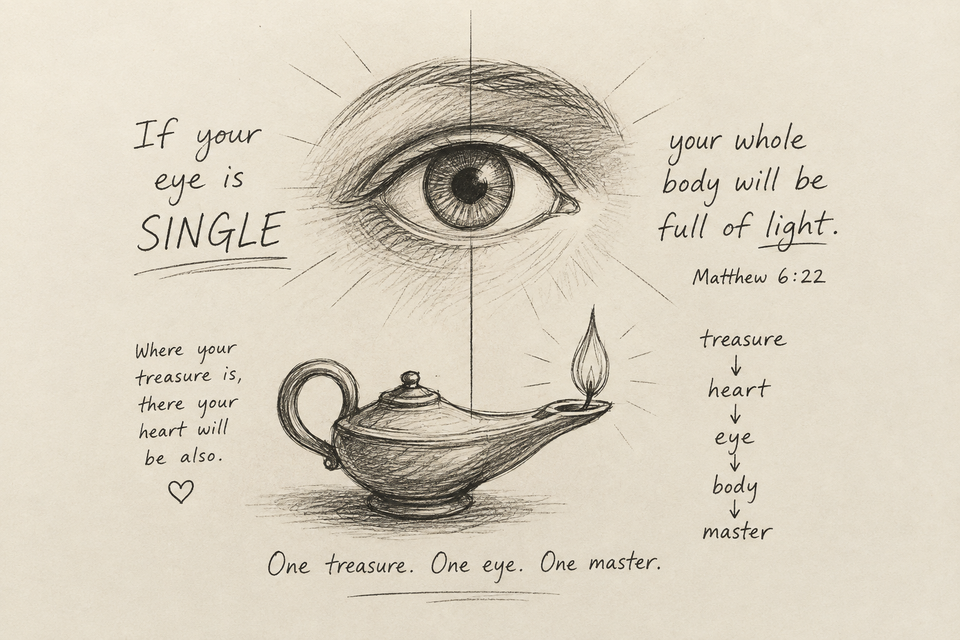
When the Heart Has Only One Treasure
There is a sentence Jesus speaks in Matthew 6 that I don’t think I have taken seriously enough.
“The lamp of the body is the eye. If therefore your eye is single, your whole body will be full of light.”
For a long time, I mostly understood this as Jesus talking about what we allow ourselves to look at. Keep your eyes pure. Be careful what you put in front of them. Don’t fill your imagination with darkness. There is obviously wisdom in that, and I don’t want to dismiss it.
But the more I have sat with the passage, the more I wonder if Jesus is talking about something underneath all of that.
He doesn’t actually say, “If your eye looks at good things.” He says, “If your eye is single.”
That word has stayed with me.
Single.
What does it mean for an eye to be single?
The context started opening this up for me. Jesus has just told His listeners not to store up treasures on earth but treasures in heaven, because where your treasure is, your heart will be there too. Then He talks about the eye. And immediately after talking about the eye, He says that no one can serve two masters. You cannot serve God and mammon.
For some reason, I had always read those as separate sayings. But what if they belong together?
Treasure. Heart. Eye. Body. Master.
There seems to be a movement happening.
Something becomes valuable to us. What we value captures the heart. The heart begins shaping the way we see. The way we see eventually works itself into the way we live. And before long, what we treasured has become what we serve.
If that is what Jesus is getting at, then the single eye is about much more than avoiding impure images.
The single eye is what happens when the heart has one treasure.
That possibility bothers me in a good way, because it means I can remove all kinds of darkness from what I physically look at and still live with double vision.
I can love Jesus and still need people to approve of me. I can believe God is my provider while quietly believing everything depends on me. I can sing about grace and then spend the rest of the week measuring whether I deserve what God has given me. I can believe that I am in Christ and still constantly watch myself to determine whether I am doing Christianity correctly.
That last one is probably more common than we realize.
There is a way of being serious about spiritual growth that slowly turns into being obsessed with yourself.
Am I praying enough? Am I hearing God clearly? Am I growing? Am I behind? Why am I struggling with this again? Why does that person seem further along than I am? Am I fulfilling my calling? Did I miss God somewhere?
None of those questions are automatically wrong. Some of them need to be asked at times. But you can live inside those questions for so long that Jesus remains the theological center of your beliefs while you remain the practical center of your attention.
You are looking at Him, but you are also watching yourself look at Him.
That is exhausting.
And I wonder if some of what we call spiritual hunger is actually spiritual anxiety. We keep checking ourselves because somewhere underneath everything we are afraid that the finished work of Jesus might still require our constant supervision.
I don’t think maturity means becoming careless about our lives. But I do think there must be a maturity that eventually delivers us from constantly taking our own spiritual temperature.
At some point, the mirror has to lose our attention.
The question begins changing from “How am I doing?” to “What is He like?”
And somewhere beyond even that question is another one that I think is much harder for many of us to receive:
What does He see when He looks at me?
We talk a lot about beholding God. Seeking His face. Looking at Jesus. Gazing upon His beauty. All of that is beautiful. But I am becoming convinced there is another side to beholding that religious people sometimes struggle to receive.
We have to allow ourselves to be beheld.
Before I ever looked for Him, He saw me.
Before I learned the language of pursuit, I was being pursued. Before I knew how to pray, before I understood worship, before I knew anything about consecration or surrender, God had already revealed His heart toward humanity in Jesus.
That changes prayer for me.
Prayer does not have to begin with trying to get God’s attention. Worship does not have to be an attempt to convince heaven that I am sincere. Holiness does not have to become an audition for intimacy.
We are responding to Someone who has already turned His face toward us.
Maybe this is where purity starts becoming something larger than simply avoiding sinful behavior.
Purity is also the absence of mixture.
Pure gold is gold without something foreign mixed into it. So what would a pure heart be?
Maybe it is a heart that is slowly losing all of its alternative sources of identity.
Jesus says, “Blessed are the pure in heart, for they shall see God.”
I used to hear that almost entirely as a reward: if you become pure enough, eventually you get to see God. But I wonder if Jesus is also describing the nature of perception itself.
The pure see God because fewer things are competing to tell them what God is like.
Fear is no longer interpreting Him.
Shame is no longer interpreting Him.
Their history is no longer interpreting Him.
Religious disappointment is no longer interpreting Him.
They are beginning to see the Father through Jesus rather than seeing the Father through everything that happened to them before they knew Jesus.
That matters more than I used to realize.
Two people can hear the word “Father” and imagine entirely different people.
Someone who has spent their life performing for love can hear “Father” and unconsciously imagine an employer. Someone carrying shame can hear “holiness” and imagine disgust. Someone shaped by abandonment can experience a quiet season with God and immediately assume He has left.
The problem in those moments is not necessarily what is in front of the eye.
Sometimes the lens itself has been wounded.
And maybe part of sanctification is God healing the lens.
That has changed the way I think about repentance too.
Jesus announces that the Kingdom of God has come near and calls people to repent. We often hear repentance primarily as “stop doing bad things.” Obviously repentance changes behavior. But it reaches deeper than behavior because it involves learning to think and see differently.
Jesus arrives and begins contradicting humanity’s assumptions about God.
We assumed God kept His distance from broken people, and Jesus sits at their tables. We assumed holiness avoided contamination, and Jesus touches lepers. We assumed sinners had to find their way back to God, and Jesus tells stories about shepherds searching for sheep, women searching for coins, and fathers running down roads.
Jesus does not merely give us new information about God.
He corrects our sight.
And that brings me back to Matthew 6, because the fact that Jesus places the single eye between treasure and mammon feels increasingly important.
Mammon is not merely money. Money can be used beautifully. The deeper seduction of mammon is the promise that something other than Father can secure your life.
If I can accumulate enough, control enough, achieve enough, become respected enough, plan carefully enough, then maybe I can finally be safe.
Mammon offers another way of seeing the world.
It teaches the eye to see scarcity everywhere.
There is not enough.
I might lose what I have.
Someone else getting ahead means I am falling behind.
Tomorrow is dangerous.
I need more before I can rest.
And once you begin seeing through that lens, your body eventually starts responding to the world you believe you live in.
Your hands grasp a little tighter. Your shoulders carry things they were never designed to carry. Your mind keeps rehearsing tomorrow. Generosity starts feeling irresponsible. Rest begins feeling dangerous. Even ambition changes. You are no longer simply creating something because you love it; you need what you create to tell you that you matter.
The body starts carrying the theology of the eye.
That may be one of the strangest parts of Jesus’ statement. He doesn’t say that if your eye is single your thoughts will be full of light.
He says your whole body will be full of light.
Apparently what we see eventually becomes embodied.
If I see myself as abandoned, my body learns to prepare for abandonment. If I see God as reluctant, my prayers learn how to beg. If I see the world primarily through scarcity, my hands learn how to grasp. If I believe my identity has to be continually proven, even my calling becomes heavy because every accomplishment is being asked to answer a question it was never designed to answer.
Who am I?
But something begins changing when Christ becomes more than the One I believe in and becomes the One through whom I interpret reality.
The body slowly begins learning what the spirit has heard.
You are home.
Maybe peace is partly what happens when contradiction begins leaving us. One part of me is no longer calling Him Father while another part prepares for abandonment. I am no longer singing about grace while secretly maintaining my own private system of worthiness. I am no longer declaring that Christ is enough while asking achievement, ministry, money or approval to make me enough.
The eye is becoming single.
This is also why I think beholding matters so much.
We sometimes talk about becoming what we behold as though staring at Jesus long enough magically changes us. But there is something more ordinary and profound happening. What we behold becomes beautiful to us. What becomes beautiful awakens desire. Desire begins arranging our decisions, and eventually our lives start taking the shape of what we love.
That is why transformation cannot simply consist of becoming increasingly knowledgeable about our darkness.
I can study my fear endlessly without becoming free from fear.
At some point I have to see something greater.
A flower does not bloom because it spends its life examining its roots. It turns toward the sun.
Maybe we have done a lot of digging around the roots.
Maybe some of it was necessary.
But eventually the heart has to see Jesus.
And when it does, holiness starts becoming less mechanical. I don’t merely stop grasping because someone told me grasping is wrong; I begin discovering Father as Provider. I don’t have to manufacture freedom from envy through sheer discipline; I begin realizing that another person’s beauty does not threaten my place at Father’s table. I don’t have to perform my way out of insecurity; belovedness begins making performance unnecessary.
The behavior changes because the world I thought I lived in has changed.
Or maybe more accurately, I am finally seeing the world that Jesus has been revealing all along.
And maybe that is what has been hiding inside this strange sentence from Matthew 6.
“If your eye is single, your whole body will be full of light.”
Jesus is not asking us to manufacture light.
He is dealing with divided vision.
The heart cannot ultimately have two treasures because eventually it will have two interpretations of reality. And two interpretations eventually produce two masters.
Maybe this is why the invitation is not simply to try harder to become pure.
It is to see Him.
To keep seeing Him until the other definitions of God begin falling away. To keep seeing Him until fear is no longer allowed to interpret Father. To keep seeing Him until scarcity stops explaining tomorrow. To keep seeing Him until our failures are no longer permitted to rewrite what the cross has said about us.
Until eventually something inside becomes quiet.
One treasure.
One eye.
One reality.
Christ is no longer merely Someone standing in the center of our theology.
He becomes the place from which we see.
And perhaps that is why the pure in heart see God.
There is finally less and less in the eye competing with Him.
If this ministry has encouraged your walk with Christ and you feel led by the Lord to partner with what He is doing, we invite you to prayerfully consider supporting this work. Every gift helps us continue sharing the truth of God’s Word and the hope of the gospel with people around the world.
There is never any obligation to give, only an opportunity to participate in what God is doing. We are deeply grateful for your prayers, your encouragement, and, if the Lord leads, your generosity.
You can give here: Awaken Ministries Donation Page
Member discussion