Why Are the Angels of God Ascending Before They Descend?
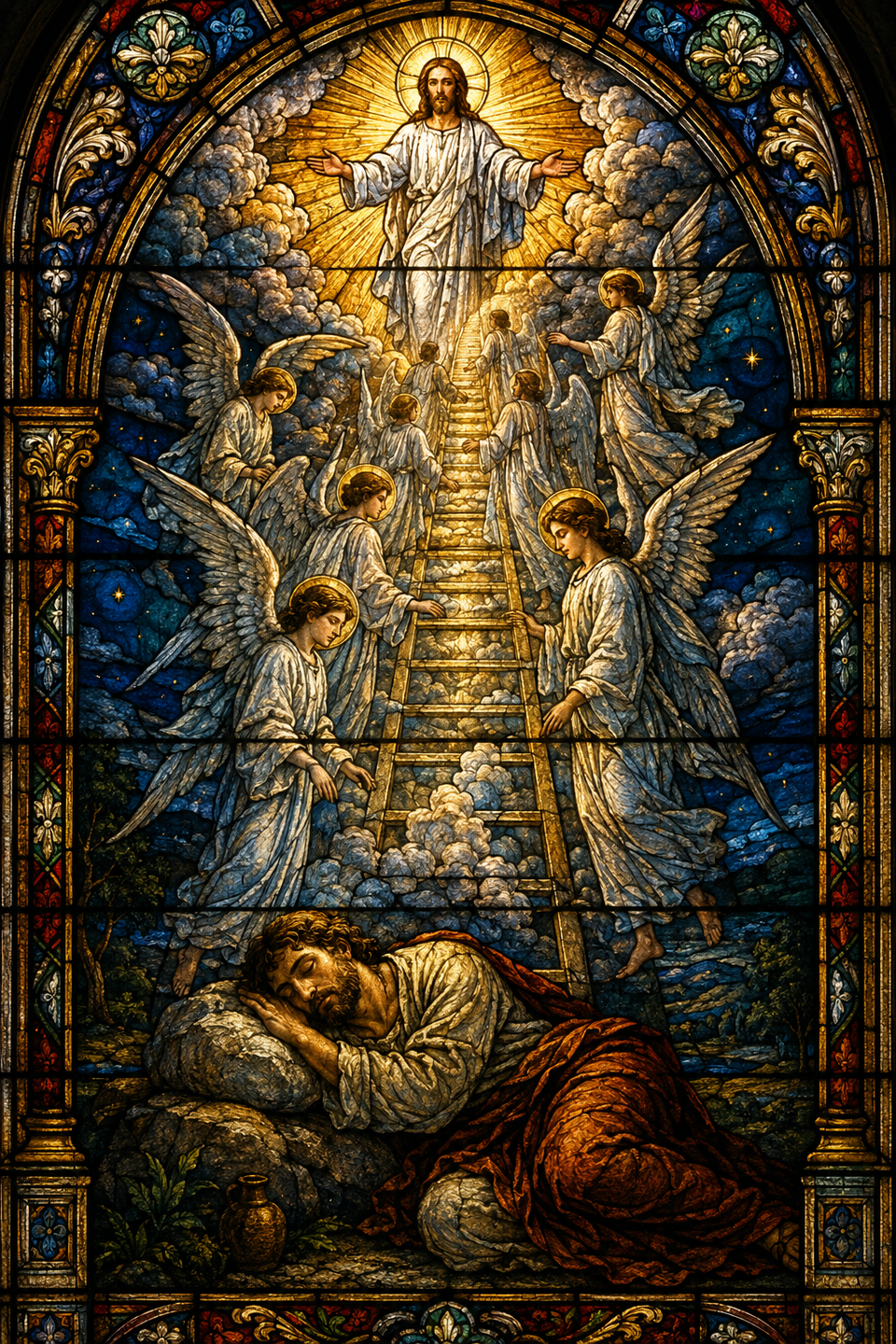
Jacob’s dream is one of the most familiar scenes in Scripture. We picture a ladder reaching from earth to heaven with angels traveling upon it, but there is a detail that is easy to overlook. Genesis 28 says Jacob saw “the angels of God ascending and descending on it.” That order is unexpected. If angels belong to heaven, why are they ascending before they descend?
Scripture never tells us. We should be careful not to build doctrine on what God has chosen not to explain. There is a difference between thoughtful reflection and confident speculation. Still, details matter. The Holy Spirit did not preserve these words by accident, and Jesus Himself later points back to this very passage. That makes the question worth considering.
One thing stands out immediately. Jacob did not seek this encounter. He was not praying for a vision or searching for a holy place. He was fleeing from his brother, uncertain about his future, and sleeping in the open with a stone for a pillow. Yet while Jacob slept, heaven was not silent.
That alone says something important. We often assume God begins to work when we become aware of Him. We sense His presence, receive an answer to prayer, or experience a breakthrough, and we think heaven has suddenly become active. Jacob’s dream challenges that assumption. The dream did not begin God’s activity. It revealed it.
When Jacob woke, he said, “Surely the Lord is in this place, and I did not know it.”
That is one of the most honest confessions in Scripture. Jacob did not say, “The Lord came here while I was asleep.” He realized that what had changed was not God’s presence but his awareness of it.
The presence of God preceded Jacob’s perception of God.
That truth reaches far beyond Bethel. How often do we mistake our awareness of God for God’s activity? We pray for wisdom, and when clarity finally comes, we imagine God has just answered. Yet perhaps He was working long before we recognized His hand. His faithfulness is not measured by our ability to see it.
With that in mind, return to the angels. Genesis simply says they were ascending and descending. It does not explain why that order is significant, if it is significant at all. We should resist saying more than Scripture says. But the picture certainly allows us to notice that Jacob seems to awaken in the middle of an already unfolding reality. Heaven is active before Jacob knows it.
That changes the way I read the passage.
Jacob thought he had stopped in an ordinary place. God knew it as covenant ground. Jacob believed he was alone. He discovered that God’s purposes had never left him.
Many believers know what that feels like. There are seasons when God’s work is difficult to recognize. Circumstances seem unchanged, prayers appear unanswered, and the future is uncertain. Jacob’s dream reminds us that our inability to see God’s work does not mean God has stopped working.
The story of Elisha’s servant teaches a similar lesson. Surrounded by an enemy army, the servant believed all hope was lost because he could only see with natural eyes. Elisha prayed that God would open his eyes, and suddenly he saw the mountain filled with horses and chariots of fire. The heavenly army did not appear at that moment. It had been there all along. What changed was not heaven but the servant’s vision.
That is why spiritual perception matters. Yet Scripture also teaches us to pursue discernment along with spiritual hunger. We are not called to chase every supernatural experience or to assume that everything extraordinary comes from God. Our desire should never be for experiences alone but for the God who reveals Himself through His Word.
Genesis helps us here by describing these beings as “the angels of God.” Those final words matter. Scripture recognizes the reality of holy angels and fallen angels. Jesus speaks of the devil and his angels. Paul warns that Satan disguises himself as an angel of light. Revelation speaks of Michael and his angels fighting the dragon and his angels.
The point is simple: not everything supernatural is from God.
That is why the Bible consistently directs our attention away from fascination with spiritual beings and toward the Lord they serve. Holy angels announce God’s purposes, protect His people, minister to His servants, and carry out His commands. They never seek worship for themselves.
When John falls before an angel in Revelation, the angel immediately stops him: “Worship God.”
That is the pattern throughout Scripture. Faithful angels always point beyond themselves.
Their greatness is not found merely in their strength but in their submission. Heaven’s servants possess authority, yet they gladly remain under God’s authority. Their power is beautiful because it is surrendered.
That gives us a helpful test for every spiritual experience. Does it make Christ more precious, or does it make the experience itself the center? Does it lead us toward humility, obedience, and worship, or simply leave us chasing another encounter?
Counterfeit spirituality often impresses before it deceives. Genuine encounters with God always deepen our love for Christ.
As important as these observations are, they are not the heart of Jacob’s dream.
The heart of the dream is revealed centuries later.
Near the beginning of John’s Gospel, Jesus speaks to Nathanael and says, “You will see heaven opened, and the angels of God ascending and descending upon the Son of Man.”
Those words are too deliberate to miss. Jesus is reaching back to Genesis 28.
But He does something remarkable.
He places Himself at the center of Jacob’s vision.
Jacob saw a ladder joining heaven and earth. Jesus says that the true meeting place between heaven and earth is not a ladder but the Son of Man.
Everything changes at that point.
Jacob believed he had discovered a sacred location. He named it Bethel, “the house of God,” because he thought he had found the gate of heaven.
Jesus reveals that the true Bethel is not a place.
It is a Person.
Jacob poured oil upon a stone. Nathanael stood before the true Anointed One.
Jacob saw a temporary picture. Nathanael met the One to whom the picture had always pointed.
The ladder was never the final point of the story.
Jesus is.
The dream was never ultimately about angels. It was about access.
Humanity’s greatest problem was never that we lacked a way to climb into heaven. Our problem was that sin had separated us from God. No amount of effort, morality, or religion could bridge that distance.
So God came to us.
John has already told us that “the Word became flesh and dwelt among us.” Heaven did not merely send another message. Heaven came near in the person of Jesus Christ.
That is the gospel hidden inside Jacob’s dream.
Religion asks how high humanity can climb.
Grace announces that God has come down.
Jesus is not another traveler upon the ladder.
He is the ladder.
Through Him heaven and earth are reconciled. Through Him sinners are brought near to the Father. Through Him access is opened that no human effort could ever achieve.
Seen in that light, the angels become part of a much greater story. Their ministry surrounds Christ rather than competing with Him. They serve God’s redemptive purposes. They rejoice over what He is accomplishing. Their activity always directs attention toward the King they obey.
That is why Christians should never become more fascinated with angels than with Christ. Scripture never discourages belief in the unseen world, but it consistently keeps Jesus at the center. Even the angels would insist upon that.
There is another lesson here worth remembering.
Jacob woke up believing he had discovered God.
In reality, God had never lost sight of Jacob.
Before Jacob understood the covenant, God was already faithful to it.
Before Jacob recognized the place as holy, God had already chosen it.
Before Jacob could see heaven’s activity, heaven was already moving.
Many of us know what it is like to live through seasons where God seems absent. We pray, wait, and wonder if He is still at work. Jacob’s story reminds us that God’s faithfulness is not suspended because our vision is limited. He remains present even when we do not recognize Him.
Perhaps that is one reason this passage continues to encourage believers. It reminds us that God’s work is often deeper than our perception. We may not understand everything He is doing, but His purposes do not depend upon our understanding.
In the end, we still cannot say with certainty why Genesis describes the angels as ascending before descending. Scripture leaves that detail unexplained, and we should leave room for that mystery.
What we do know is what Jesus tells us.
Jacob’s dream finds its fulfillment in Him.
The true house of God is Christ.
The true meeting place of heaven and earth is Christ.
The true access to the Father is Christ.
The wonder of the story is not ultimately the angels or even the ladder. The wonder is the Son of God, who came to reconcile sinners to the Father and open the way that we could never open ourselves.
Jacob woke and confessed, “Surely the Lord is in this place, and I did not know it.”
That is still a fitting confession for God’s people today. We often recognize His work only after He has already been faithful. We discover His guidance only after He has already been leading us. We become aware of His presence only to realize He has never left.
Jacob saw angels moving between heaven and earth.
Nathanael saw the One who gives that movement its meaning.
The wonder is not simply that heaven is active.
The wonder is Christ, through whom heaven has come near.
If this ministry has encouraged your walk with Christ and you feel led by the Lord to partner with what He is doing, we invite you to prayerfully consider supporting this work. Every gift helps us continue sharing the truth of God’s Word and the hope of the gospel with people around the world.
There is never any obligation to give, only an opportunity to participate in what God is doing. We are deeply grateful for your prayers, your encouragement, and, if the Lord leads, your generosity.
You can give here: Awaken Ministries Donation Page
Member discussion