When a Queen Bowed Before Wisdom
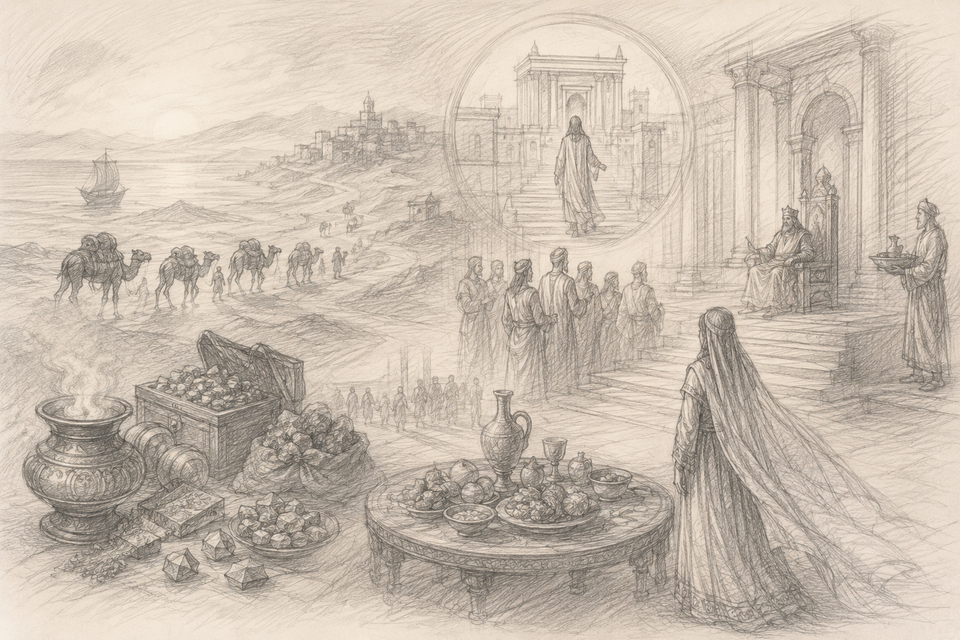
The Queen of Sheba did not set out across the wilderness because she wanted Solomon’s wealth. She already ruled a prosperous kingdom whose caravans carried gold, spices, frankincense, and precious stones along the ancient trade routes of Arabia. She knew what prosperity looked like because she lived in the middle of it. Yet there came a point when riches could no longer answer the deeper questions of the heart.
First Kings tells us that she heard “of the fame of Solomon concerning the name of the Lord.” That small phrase gives us the key to the entire account. Solomon’s reputation was tied to the God who had given him wisdom. People were not simply talking about an unusually gifted king; they were talking about what God had done through him. The Queen’s journey was more than a diplomatic visit. In many ways, it became a search for the source of Solomon’s wisdom.
History helps us appreciate the significance of her decision. The kingdom of Sheba, commonly associated with the Sabaean civilization in southern Arabia, prospered because it controlled the trade of incense, spices, gold, and precious stones. Frankincense and myrrh were among the most valuable commodities of the ancient world, used in worship, medicine, burial, and royal ceremonies. Her kingdom measured wealth every day, yet she was willing to leave its security behind because she believed there was something she did not possess.
The journey itself says something about her character. Pride rarely goes looking for answers outside itself. Humility does. Every mile across the desert acknowledged the possibility that someone else had received wisdom she lacked. Before Solomon ever spoke to her, her willingness to come had already revealed an open heart.
When she arrived, Scripture says she came to test Solomon with hard questions. A verse later we are told that she “communed with him of all that was in her heart.” That detail is easy to overlook, but it changes the scene. Her questions were not merely intellectual exercises. They reflected the concerns she carried within. Even a queen has burdens that cannot be solved by wealth or power.
One detail has always stood out to me. Scripture never tells us what those questions were. Instead, it records that Solomon answered them all. The questions disappear from the story, but the wisdom remains. There is something fitting about that. When God gives wisdom, our attention is often drawn away from the problem itself and toward the One who provides understanding.
The narrative then slows down and invites us to notice what the Queen saw as she walked through Solomon’s kingdom. She observed his house, the food at his table, the seating of his servants, the attendance of his ministers, their clothing, his cupbearers, and finally his ascent to the house of the Lord.
At first those details can seem unrelated, almost like a list without a clear purpose. But taken together they tell a single story. The Queen did not learn about Solomon’s wisdom only by listening to him. She saw its effects everywhere she looked.
His table reflected generosity and abundance. His servants carried out their responsibilities with joy. Order marked the life of the kingdom rather than confusion. Wisdom had shaped daily life, not merely royal speeches. It had become part of the culture of the kingdom.
I find it striking that Scripture mentions the table before the throne. Thrones display authority, but tables reveal fellowship. A king may rule from a distance, yet a table reminds us that people are welcomed into his presence. Long before Christ declared Himself to be the Bread of Life, Solomon’s table hinted that God’s kingdom is marked not only by authority but also by provision.
The Queen also noticed the servants, and their happiness left a deep impression on her. She exclaimed, “Happy are thy men, happy are these thy servants.” Wise leadership is measured not only by the success of the ruler but by the well-being of those under his care. Fear may produce outward obedience, but wisdom cultivates faithful and flourishing people.
Even the servants’ garments caught her attention. Throughout Scripture, clothing often points beyond appearance to identity. Joseph received a robe that marked favor. The high priest ministered in holy garments. The prodigal son was given a robe when he returned to his father. In the New Testament, believers are clothed with Christ Himself. The appearance of Solomon’s servants reflected the honor of serving such a king.
The cupbearers are mentioned only briefly, yet their role was significant. They stood close to the king and accepted personal risk in order to protect him. Their quiet faithfulness reminds us that faithful service is often unseen. In time, Christ would take upon Himself a far greater burden, drinking the cup of judgment so that His people might receive the cup of salvation. Solomon’s kingdom offers only a faint shadow of what would be fully revealed in the gospel.
The final observation affected the Queen more than all the others. She watched Solomon ascend to the house of the Lord, and Scripture says, “there was no more spirit in her.” It was not simply the beauty of the palace or the organization of the kingdom that overwhelmed her. She saw that the king himself lived in worship before God.
At that moment the rest of the picture came into focus.
The kingdom was ordered because its ruler first submitted himself to the Lord.
Its generosity flowed from a king who recognized that every blessing had been received.
Its beauty reflected a heart that honored God before seeking honor for itself.
The visible strength of the kingdom rested upon an invisible foundation.
That pattern appears throughout Scripture. God entrusts honor to those who first humble themselves before Him. Solomon’s throne did not create his greatness; it displayed the wisdom God had graciously given. His authority remained healthy because he understood that he himself lived under a greater authority.
This also explains why Solomon’s example stands in such sharp contrast to Lucifer’s rebellion. Pride reaches upward to exalt itself. Humility draws near to God in worship. Solomon’s ascent was not an attempt to seize glory but an acknowledgment that all glory belonged to the Lord. The Queen recognized that what made Solomon great was not Solomon alone but the God whom he served.
Jesus later revealed the fullest meaning of this encounter when He declared, “The queen of the south shall rise up in the judgment with this generation… for she came from the uttermost parts of the earth to hear the wisdom of Solomon; and behold, a greater than Solomon is here.”
The comparison is remarkable.
Solomon received wisdom from God.
Jesus is the wisdom of God.
Solomon prepared a table for his household.
Jesus gives Himself as the Bread of Life.
Solomon’s servants reflected the dignity of their king.
Jesus clothes His people in His own righteousness.
Solomon ascended to worship in the house of the Lord.
Jesus entered the heavenly sanctuary after offering Himself once for all.
The Queen crossed deserts to hear wisdom that had been given to another. We are invited to come directly to the One in whom all the treasures of wisdom and knowledge are found.
There is also a quiet warning in the story. A Gentile queen traveled a great distance because she believed God’s wisdom was worth seeking. Yet many who stood in the very presence of Christ refused Him. The greatest obstacle was never geography. It was the unwillingness to humble the heart.
In the end, the Queen of Sheba’s journey is not simply the story of an extraordinary ruler visiting another extraordinary ruler. It is the story of humility recognizing the work of God. She valued truth more than reputation and worship more than appearances. Her journey ultimately points beyond Solomon to Christ, the true and greater King, whose wisdom still welcomes every humble soul to His table.
If this ministry has encouraged your walk with Christ and you feel led by the Lord to partner with what He is doing, we invite you to prayerfully consider supporting this work. Every gift helps us continue sharing the truth of God’s Word and the hope of the gospel with people around the world.
There is never any obligation to give, only an opportunity to participate in what God is doing. We are deeply grateful for your prayers, your encouragement, and, if the Lord leads, your generosity.
You can give here: Awaken Ministries Donation Page
Member discussion